
The bell rings and the clock starts at sixty. In Bangkok your fighter would get double that, because Lumpinee and Rajadamnern run five three-minute rounds with a full two minutes of rest, long enough for a trainer to work his thighs, talk, and still leave him sitting in silence. At an amateur show in a hotel ballroom in Cleveland there is one minute, and by the time three people have climbed through the ropes and started talking over each other, half of it is gone.
Search for roundhouse kick tutorials and you drown in them. Search for how to corner a fighter and there is nothing. Here is that minute in pieces, with my position up front: most amateur corners talk far too much and say almost nothing a tired fighter can use.
The first ten seconds belong to the body
They are not yours. They belong to his lungs.
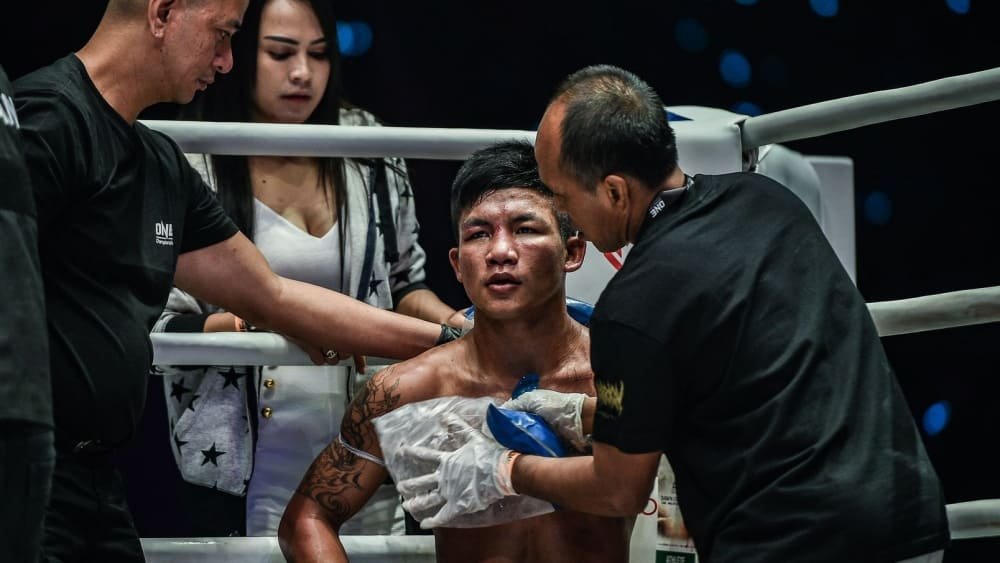
The stool goes in the instant the bell sounds, and fast, because every second you spend fumbling with the ropes comes out of the sixty. Sit him upright. Chest open, head up, hands on his thighs instead of hanging over his knees, because a fighter folded forward is breathing into a closed box. Watch Thai corners and you will often see a second move: two men lift the fighter under the armpits, hold him clear of the stool for about five seconds, then set him back down. That opens the hips and takes the load off a back braced for three minutes. It does something for his head too, which may be the bigger half of it.
Say nothing while this happens. His heart rate is near the ceiling, his ears are ringing, and language is not getting through. Wipe his face, get ice on the back of his neck, let him breathe through the nose. Ten seconds of quiet feels endless when you are holding the towel. Hold it anyway.
Water, ice, and what the rules actually let you touch
Water first, and less than instinct tells you. Tip the bottle for him in small amounts and let him swill and spit into the bucket. A fighter who gulps half a bottle at the end of round two feels it sloshing in round three, and nobody goes out with a mouth still full.
Now the rules, which amateurs get wrong constantly. Under IFMA rules, the framework most North American sanctioning bodies are built on, a reasonable amount of Vaseline is permitted on the face only, and only to reduce the risk of cuts. Anywhere below the neck, grease is forbidden outright, and a referee who thinks you have laid it on thick will make you wipe it off before the round starts. Thai liniment is stricter still: most amateur rulesets allow it for warming up, below the shoulders, and not once the first bell has gone. Some organizations check gloves before every round for exactly this reason. If you want the chemistry, we went through what namman muay does in its own piece.
Swelling is where a corner earns its keep. Ice in a bag or wrapped in a wet towel, pressed flat against the bone under the eye with firm steady pressure for as long as you have. Not rubbed. Not dabbed on and lifted every three seconds so you can look at it. The steel enswell boxing cutmen use to iron a hematoma flat is a professional tool most amateur shows will not let you carry, and coagulants such as adrenaline 1/1000 need the ring doctor’s approval anyway.
And dry your corner. Water splashed on the canvas is a slip waiting to happen, and your fighter is the one who plants a foot on it.
One instruction is the whole budget
You have roughly twenty-five usable seconds and one free slot in his working memory. One.
Hand him five things and he executes none of them. A coach fires off “be first, hands up, more knees, stop walking backwards, and watch that elbow” in one breath, and his fighter goes out and repeats the previous round exactly. That is not a fighter refusing to listen. That is a corner handing him a to-do list at the one moment his brain can hold a single line.
Pick the change that moves the fight most. Say it, then say it again in the same words, because repetition of one line is how it sticks and a second competing line is how it does not.
The last ten seconds
Somebody in the corner should own the clock and do nothing else. Their whole job is calling “thirty” and “ten” so the person talking knows what budget is left. Easiest role to fill, and the one most amateur corners skip.
At ten: last sip, rinse, mouthpiece in and seated properly. Grease if the rules allow it. Stand him up, give him one word rather than a fresh idea, and then everything comes out of the ring. The stool, the bucket, the towels, the bottle, and you. Getting caught in the ropes when the bell goes puts the referee’s attention on you instead of the fight.
So what does a usable instruction sound like?
The test is simple. A usable instruction names one action and ties it to something the opponent does. A useless one names a category.
“Be first” is a category. So are “more knees”, “work the body” and “hands up”. Your fighter knows his hands are down. What he does not know is how to hold them up in round three with his shoulders full of acid, and “hands up” does not tell him that.
Compare these:
- “He drops his lead hand every time he kicks. Catch it and cross over the top.”
- “He resets straight backwards after his combination. Teep him the second he stops.”
- “Three low kicks on his lead leg this round. Only three. Make them count.”
- “He fights in bursts of two. Cover, then go on the third beat.”
Every one has a trigger and an action, and two carry a number. Numbers work because an exhausted brain can still count. “Kick more” has no finish line; “three low kicks” does.
When your fighter is winning, the correct instruction is “same again, change nothing.” Corners hate this, because saying almost nothing feels like not coaching, and the urge to justify your place on the apron wrecks more rounds than any bad read of the opponent.
Down two rounds with one to go
Tell him. Some good coaches disagree with me here and their reasoning is fair: a fighter who learns he is losing tends to panic and swing, and swinging turns a narrow decision loss into a knockout loss. But a fighter who assumes he is ahead will coast, and coasting through the last round is how people lose fights they had in hand.
The trick is attaching an action to the news. Not “you’re down two, you have to win this round,” but “you need the finish, so his lead leg for thirty seconds, then go upstairs.” Information plus a plan is usable. Information alone is anxiety with a countdown.
Know which scoring system is sitting ringside, too. Under Thai judging the bout is weighed as a whole with the middle rounds carrying most of the freight, so trailing after two is not the deficit it looks like on a Western card. Thai and Western judges read the same three minutes differently, and a corner guessing at that is coaching blind.
Thai corners almost never stop the fight
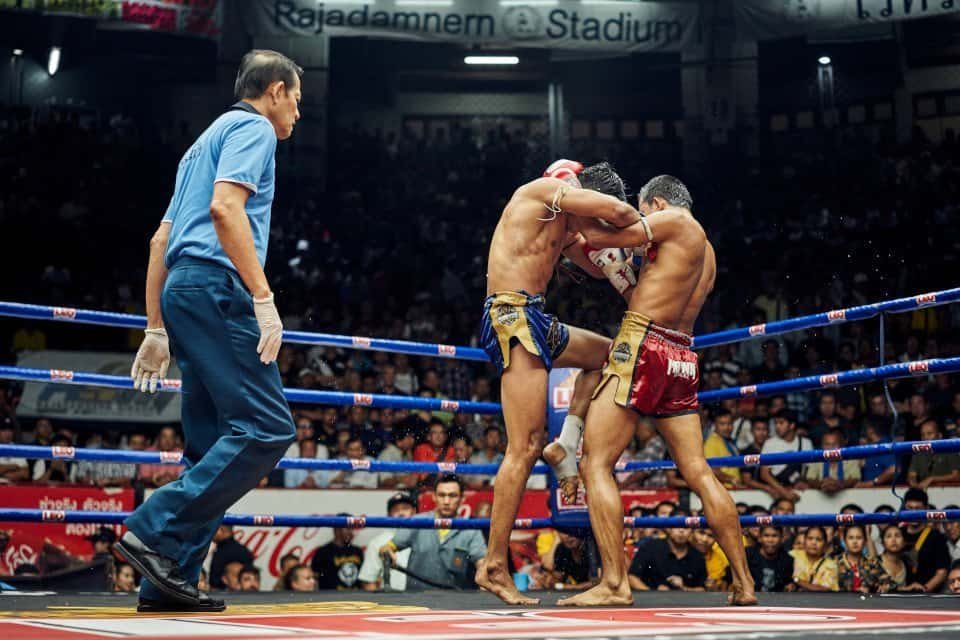
Watch enough stadium Muay Thai and you notice how rarely a towel comes in. Fights in Thailand get stopped by the referee, who is much quicker than his Western counterpart to wave off a one-sided contest, and by the doctor. The corner usually stays out of it. Some of that is money, since a gambling economy surrounds every stadium card and the fighter’s backer, the pee liang, is often standing right there. Some of it is career: a fighter who gets saved acquires a reputation for needing saving, and in a country where a man might fight two hundred times before he turns thirty, reputation is income.
Do not copy this. In a North American amateur bout you hold more authority and nothing financial is at stake, and the towel is the right call far more often than people use it. The signs are not subtle. He stops answering you between rounds. Watch whether his stance widens and his legs stiffen, and whether he reacts to clean shots at all, because a fighter still in the contest flinches or blocks or fires back, while one who is done simply absorbs. Getting dropped twice by the same punch he never saw is the last signal. Any two of those and you end it.
Cornering someone for the first time
If a training partner has asked you to work their corner and you have never done it, keep it to this:
- Bring your own kit and assume the promoter has nothing: bottle with a spout, bucket, two towels, gauze, tape, blunt-tipped scissors, cotton swabs, a spare mouthpiece, and Vaseline if your ruleset allows it. Get ice from the venue early.
- Watch the bout before yours from the floor, so you learn how this referee and timekeeper handle the ten-second warning.
- Agree beforehand who speaks. One voice only. The second person handles water, ice, and the clock.
- Do not shout technique from the apron during the round. Yelling “throw six” announces the shot to the opposite corner, who will pass it on in their own sixty seconds.
- Ask one question when he sits down, then listen. “How are your legs?” tells you more than anything you saw from outside the ropes.
- Know where the referee is and how you signal a stoppage before you need to.
None of this is glamorous and nobody films it. The measure of a corner is not volume, and not how clever the read was. Ask one question after the fight: did he do anything differently in round three? If the answer is no, that minute was wasted, however much got said inside it.