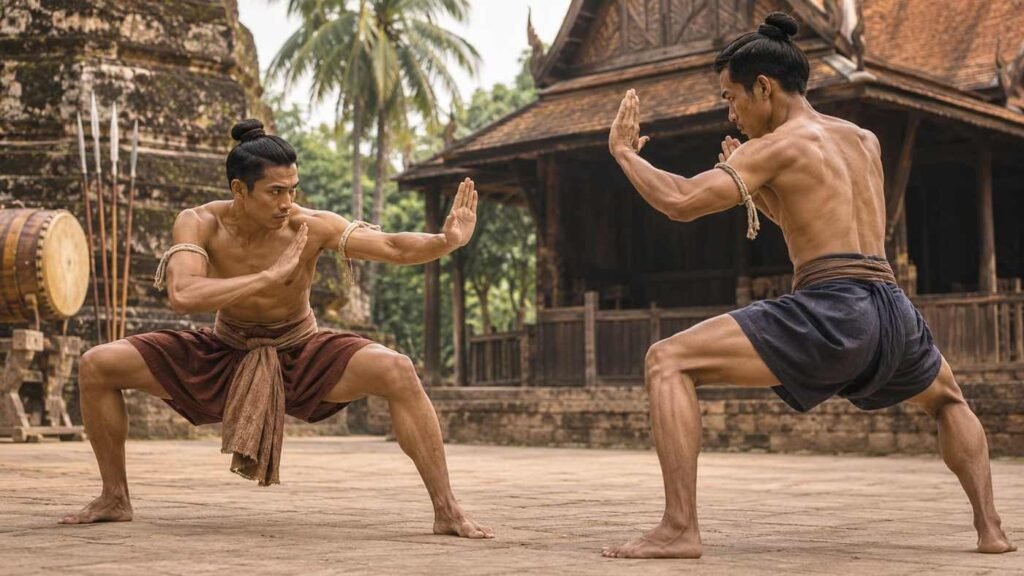
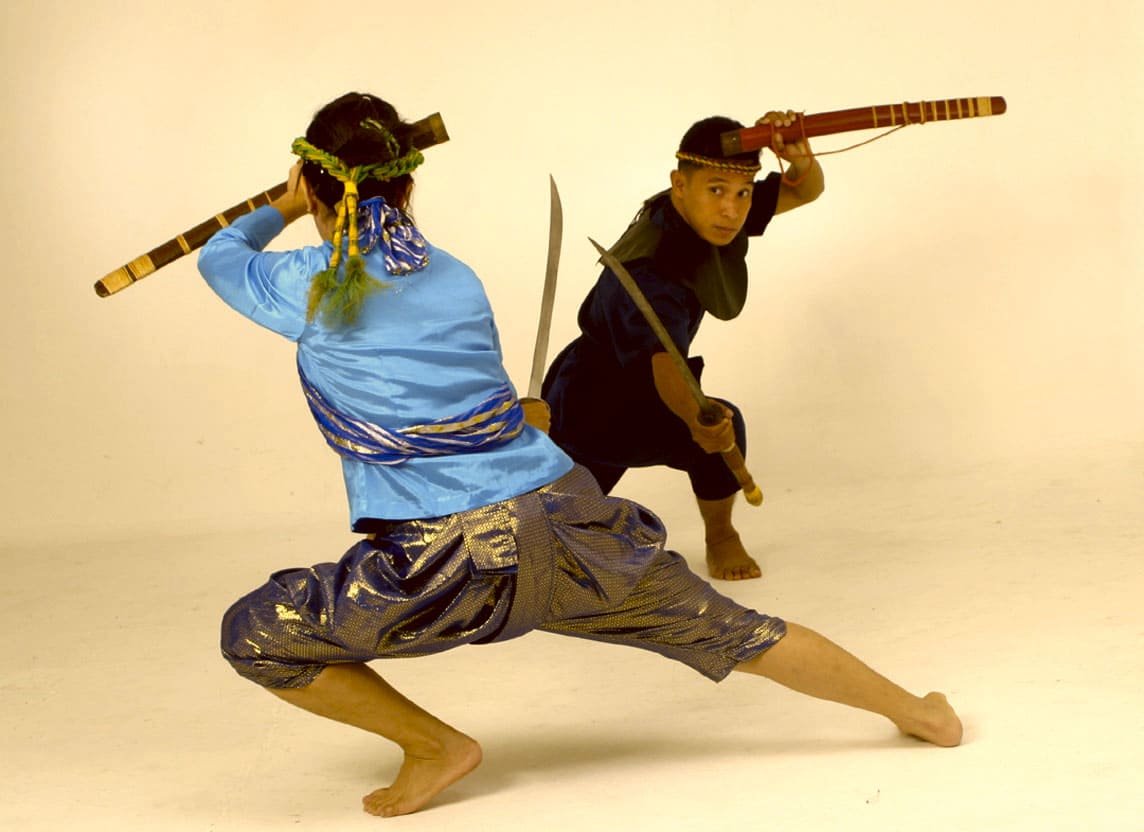
Most visitors to Thailand see krabi krabong by accident. There is a festival, a temple fair, a cultural show laid on for a tour group, and suddenly two men in shorts are circling each other with rattan swords while a reed pipe wails and a pair of drums argues underneath it. The men bow three times before they start, which puzzles the tourists.
Anyone who has watched Muay Thai will recognize half of what happens. That is the interesting part. Krabi krabong, the Thai art of fighting with blades, staffs, and shields, is the older, stranger relative of the ring sport, and the family resemblance shows up in the music, the rituals, the headgear, and even the way the fighters walk.
A Monkey, a Giant, and Two Words
Thai sources admit, with a candor I find refreshing, that nobody knows who invented the art or when. What people do argue about is the name.
The most persuasive explanation comes from the Ramakien, the Thai version of the Ramayana. In the masked khon theater, the narrator calls Hanuman, chief of the monkey army, khun krabi. Hanuman is small and quick and carries a short trident, and his monkey soldiers carry short swords. The demons (yak) on the other side are huge, slow, and armed with clubs, which in Thai are krabong.
So the two words split the arsenal in half:
- Krabi covers short weapons: swords, shields, forearm clubs, daggers, sickles, axes, and short tridents. Monkey weapons, fast and close.
- Krabong covers long weapons: staffs, clubs, halberds, lances, and spears. Giant weapons, which work best at the outer range.
One classic demonstration pairing backs the theory up: forearm clubs against the staff, monkey against giant.
Oddly, under the first Chakri kings nobody spoke of “krabi krabong” at all. There were sword duels and spear duels, and a skilled fencer was simply a nak dap, a swordsman. The combined term arrived after the reign of Rama I.
What Comes Out of the Kit Bag
Practitioners call their equipment khrueang mai, roughly “the wooden gear.” It comes in two versions. The display set (mai ram) is lacquered, gilded, sometimes inlaid with tiny mirrors, and far too delicate to strike with. The sparring set (mai ti) is plain rattan or root wood, built to be light, tough, and ugly.
| Weapon | Thai term | The real thing | Training version |
| Sabre | krabi | Straight, flat, pointed steel blade, about 90 cm, one-handed, with a basket guard | Rattan, about 100 cm, cord-wrapped and lacquered |
| Sword | dap | About 90 cm, slightly curved, weight toward the tip for heavier cuts; often used in pairs | Lightweight rattan so it bends instead of snapping |
| Halberd | ngao | Curved blade on a pole about 220 cm long, used on foot and from the backs of elephants | Rattan, blade padded with thick cloth or felt |
| Staff | phlong | A round pole four sok (forearm lengths) long, held in the middle, used at both ends | Banyan aerial root, ends wrapped in felt |
| Long shield | dang | Curved, about 15 cm wide and 100 cm long, paired with a sword | Hide, rattan, or wood |
| Rectangular shield | khen | Flat rawhide, often lacquered and gilded outside | Same, used as is |
| Round shield | lo | Domed like a wok, rawhide, woven rattan, or metal, with two loops for arm and hand | Same, used as is |
| Forearm clubs | mai sok / mai san | Wooden bars about 45 cm long strapped along each forearm, used against the staff | Banyan wood, hollowed to fit the arm |
The krabi deserves a footnote. Some troupes built a special fighting sabre with a tip of twisted buffalo hide that flexed like a whip. Block too close to the hilt and the tip wraps around and stings you. Block the tip itself and it slides off and hits you anyway. The Thai text notes, drily, that anyone who plays this version needs a high tolerance for pain.
That tolerance was part of the point. Old-style practice used no armor, and nothing on the body was off limits. The reasoning was simple: an enemy on a battlefield does not follow rules either. Teachers framed the training around three aims, which translate well enough into English: make the mind brave, keep body and spirit hard enough for the miseries of war, and become precise and expert in the actual business of fighting.
Bowing Before a Krabi Krabong Bout
A display opens slowly, which frustrates spectators who came for the whacking. First comes thawai bangkhom, a triple bow once performed because the contests were held before the king. Each bow now has its own meaning:
- Respect for the teachings of the Buddha.
- Respect for the head of the nation.
- Respect for parents, teachers, and everyone who passed the knowledge down.
Then the fighters perform khuen phrom, “raising the Brahma,” a formal opening sequence done either kneeling (phrom nang) or standing (phrom yuen), the two partners facing each other. Both end in the guard called khum ram.
Before any of that, the troupe leader offers flowers, incense, and candles to the art’s teachers in front of the weapons, with the performers gathered around him. That ceremony is a wai khru, the same act of homage every Muay Thai fighter performs before a bout, and it carries the same weight. Thai combat arts have always had one foot in the temple, and the rituals Thai fighters swear by did not appear out of nowhere.
Kings Who Fenced, and Kings Who Didn’t
The art’s fortunes rose and fell with royal taste. As far back as the reign of King Narai in the 17th century, boxing matches and armed contests were staged before the throne, and bouts against foreigners, Westerners with their own weapons, drew the biggest crowds.
King Mongkut (Rama IV) was the great patron. He had studied both boxing and krabi krabong with a court master, Luang Mon Yothanuyok, and during his reign weapon bouts and Muay Thai matches were regular fixtures at royal celebrations. He watched them and handed out prizes, and troupes multiplied across the capital. In 1866, when the future King Chulalongkorn was ordained as a novice monk, several young princes performed krabi krabong in front of the ordination hall of Wat Phra Kaew, in pairs by weapon: sabre, staff, halberd, and the two-handed double sword.
Under Chulalongkorn the art turned up at topknot-cutting ceremonies, ordinations, and temple festivals. Then the enthusiasm cooled. Rama VI understood the art but preferred theater. The Ministry of Education still staged displays for him in 1917 and 1919, yet by the reign of Rama VII krabi krabong had become hard to find anywhere.
The revival came from politics. After the 1932 change to constitutional monarchy, the government promoted lavish New Year celebrations, and in 1939 it put on a krabi krabong show at Sanam Luang, the big field by the Grand Palace. The public loved it. From 1941 there was a deliberate push to rebuild the sport, and the number of troupes grew fast.
The Schoolmaster Who Wrote It into the Timetable
The person who actually saved the art was a teacher, which is often how these things go. Nak Thephasadin na Ayutthaya had learned krabi krabong as a boy. As principal of the Central Physical Education School in Bangkok, he tried it out on his students in 1935. The trial year went well, and in 1936 it became part of the physical education teachers’ course. His graduates went off to teach in the provinces and took the art with them.
In 1975 the Ministry of Education made krabi krabong a compulsory part of physical education in Mathayom 4 (roughly tenth grade), and in 1978 a first krabi course became compulsory in Mathayom 2. So a great many Thai adults have stood in a school field holding a rattan sabre, feeling faintly ridiculous.
Twelve Moves with Poetic Names
Students begin with the mai ram, twelve set dance forms for the sabre. Each one is a short walking pattern built from the same vocabulary: a step, a slow drawing-in of the rear foot, a knee raised to a right angle and held still, a turn, and a flourish of the free hand. The names are worth the price of admission:
- Loi chai: strolling at ease, a zigzag walk.
- Khuang tat: twirl the sabre twice, raise it beside the ear.
- Suea lak hang: the tiger drags its tail.
- Tang sok: the raised elbow, resting on the lifted knee.
- Chuang na chuang lang: lunge forward, lunge back.
- Pok na pok lang: cover the front, cover the back.
- Tha yak: the giant’s stance, knees bent, cutting in a cross.
- Soi dao: picking stars, the blade thrust upward.
- Khuang tae: twirl and touch.
- Hanuman waek fong nam: Hanuman parts the sea foam, arms sweeping like a swimmer.
- Lot lo: lower and lure, a feint.
- Choen thian: presenting the candle.
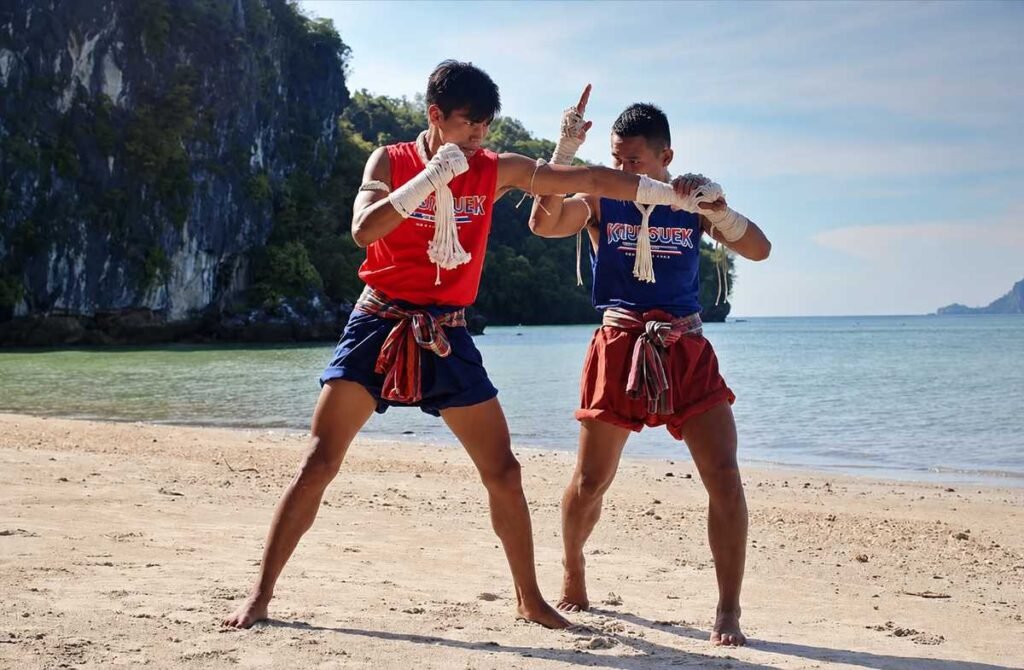
Watch a Muay Thai fighter’s ram muay and then watch these, and the similarities are hard to miss: the raised knee held for balance, the slow stalking steps, the turns toward each point of the compass.
Where Muay Thai Shares the Stage
The strongest link is the soundtrack. According to the Thai account, the idea of accompanying weapon play and boxing with music came from Javanese performers, who played for kris and spear displays and for boxing with only a Javanese oboe and drums. The Thais liked it, borrowed it, and added small cymbals. The ensemble is still four instruments: the pi chawa, a male drum (klong khaek tua phu) with a high voice, a female drum (tua mia) with a low one, and the ching keeping time.
The music follows a fixed order: pieces for the wai khru, an overture, then accompaniment for each weapon, with the sabre, halberd, and staff each getting their own tunes. During the dance the drums play loose and slow. When the fighters close and start striking, the rhythm tightens and speeds up to push them on. Any fight fan will know that shift, and it pays to start watching the band at a Muay Thai card for the same reason.
Old-time fighters dressed as warriors, in sleeveless yantra shirts and wide calf-length trousers. Modern players wear athletic shorts, but one item never changed. Every player wears the mongkhon, a headband made from many strands of sacred cotton thread twisted into one cord, a little thicker than a thumb, wrapped in cloth, with the two ends sticking out like the wick of a candle. It is blessed in a Buddhist ceremony first, and in some troupes the teacher places it on the student’s head himself. Muay Thai took the custom whole, and the mongkhon and pra jiad a boxer wears into the ring are direct descendants of it.
If you get the chance to see a krabi krabong display in Thailand, skip the first rush for photos and watch the feet during the twelve forms. Then watch the forearm clubs against the staff, the monkey against the giant. The same tight elbows, stacked guards, and patient footwork are what you will see later that night in a Muay Thai ring, without the rattan.