Ask a beginner what pad holders use in Muay Thai and most will say “Thai pads” and stop there. That’s the gap. A working gym owns at least five different pieces of holding gear, each built for a different strike, a different level of holder skill, and a different point in a student’s training. Buy the wrong one first and either the gear sits unused in a bag or someone gets hurt absorbing a kick it was never designed to take.
This guide breaks down what each piece actually does, who should be holding it, and what a home training setup needs at minimum.
The Pad Holder’s Arsenal
Five tools cover almost everything a holder needs.
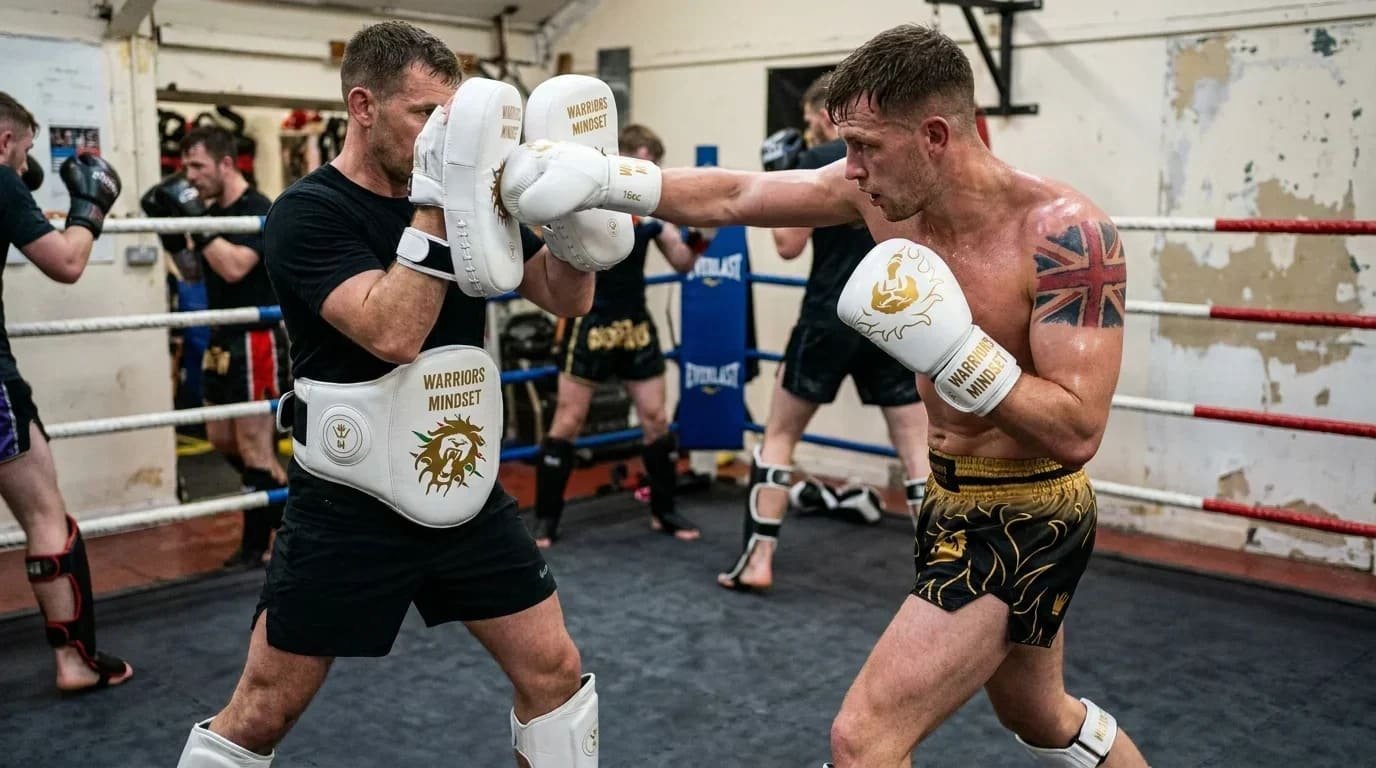
Thai pads are the pair worn on the forearms, used for combination work: punches, elbows, knees, and kicks all land here. Focus mitts are the smaller, lighter pair borrowed straight from boxing gyms, built for hand speed and not much else. The belly pad, sometimes called a body shield, straps to the holder’s torso and takes knees and teeps directly to the midsection. A kick shield is a single large cushioned pad, held with both arms, that soaks up full-power roundhouse kicks. Finally, a thigh pad (also sold as a leg shield) straps onto the holder’s own leg so a partner can practice low kicks without either person getting hurt.
None of these substitute for another. A Thai pad pair can technically catch a low kick, but the holder’s forearms take the shock transfer, and after enough rounds that adds up.
Thai Pads vs Focus Mitts
The two look similar from across the room. They are not interchangeable.
Focus mitts weigh next to nothing and move fast, which is the entire point; they train hand speed, combinations, and reaction timing off quick calls from the holder. Thai pads weigh more, sit thicker, and stay mostly stationary during a round. A holder plants them and lets the striker work through knees and kicks as well as punches. Try holding Thai pads the way you’d hold focus mitts, snapping them around for hand drills, and the weight will wreck your shoulders inside ten minutes.
Here’s the distinction that trips people up: focus mitts came from Western boxing and were adopted into Muay Thai gyms because hand-speed drills still matter in the sport. Thai pads were built specifically for Muay Thai’s full range of weapons. A gym running true Muay Thai classes needs both, but if a budget only allows one pair, Thai pads cover more ground.
The Belly Pad: Most Underrated Gear
Ask ten Muay Thai gyms which piece of equipment gets ignored the longest and most will say the belly pad. That’s a mistake, because knees and teeps (the push kick) don’t have anywhere else to land safely in partner drilling. A holder without a belly pad either takes knees on bare stomach padding meant for kicks, which is uncomfortable at best, or the pair skips knee work entirely.
The belly pad straps around the holder’s torso with shoulder loops and a waist belt, leaving both hands free to hold focus mitts or a second small pad at the same time. That combination, belly pad plus mitts, lets one holder run a full combination: jab, cross, teep, knee, all in one sequence, without swapping gear mid-drill. Few other setups pack that much versatility into one piece of equipment.
Kick Shields
Kick shields exist for one job: absorbing power that would otherwise go into a holder’s arms unprotected. They’re big, curved, and held against the chest with both forearms tucked through straps on the back.
A beginner throwing kicks needs something bigger than Thai pads to aim at, and a kick shield gives a wide, forgiving target. More importantly, once a striker starts loading real power into roundhouse kicks, a kick shield is the only piece of gear rated to take it repeatedly without the holder absorbing joint-level shock. Holding one well takes more than standing still. The holder has to angle the shield into the kick, brace the back leg, and absorb through the whole body rather than just the arms. A holder who locks their knees on a hard kick usually ends up on the ground.
What to Buy for Home Partner Training on a Budget
Two people training at home don’t need five pieces of gear on day one.
The minimum viable setup is a pair of Thai pads and a belly pad. Thai pads handle punches, elbows, and most kicks in combination drills. The belly pad covers knees and teeps, which Thai pads alone don’t absorb well. Together they cover roughly 80% of what a beginner curriculum actually drills. Focus mitts, a kick shield, and a thigh pad can wait until the budget allows it or the training gets more advanced.
Sizing and When to Replace
| Equipment | Strikes it takes | Holder experience needed |
| Thai pads | Punches, elbows, knees, kicks | Beginner to intermediate |
| Focus mitts | Punches only | Beginner |
| Belly pad | Knees, teeps (push kicks) | Beginner |
| Kick shield | Power roundhouse kicks | Intermediate to advanced |
| Thigh pad | Low kicks | Intermediate |
Thai pads come in standard and long versions; long pads add a few extra inches of surface and suit taller holders or bigger strikers who need more room to land cleanly. Weight matters too, heavier foam lasts longer but tires the arms faster during long rounds, so most gyms settle on a mid-weight pad as the everyday choice.
Replace gear once the foam compresses to the point where you can feel a strike land on the backing plate rather than the padding. Cracked vinyl on a kick shield isn’t just cosmetic; once the outer shell splits, water and sweat get into the foam core and it breaks down fast from there. A belly pad with loose or frayed straps is a safety issue on its own, since a strap failure mid-drill can mean a knee landing somewhere it shouldn’t. None of this gear is built to last forever. Treat visible wear as the deadline, not a reason to squeeze out one more month.
FAQ
Do I need a kick shield if I already have Thai pads? Eventually, yes. Thai pads can take light kicks, but once a partner starts throwing full power, the shield protects the holder’s arms in a way Thai pads can’t match.
What size Thai pads should a beginner buy? Standard size works for most adult training pairs. Long pads only make sense if the holder is notably tall or the striker has a longer reach than average.