
Walk into a beginner class anywhere in the US or Canada and you can spot the two extremes in about four seconds. One guy is wearing $40 gloves off Amazon that have held up fine for eight months. Another bought a $600 kit before his third session, including headgear he has never once put on, and he is still learning to switch stance without tripping.
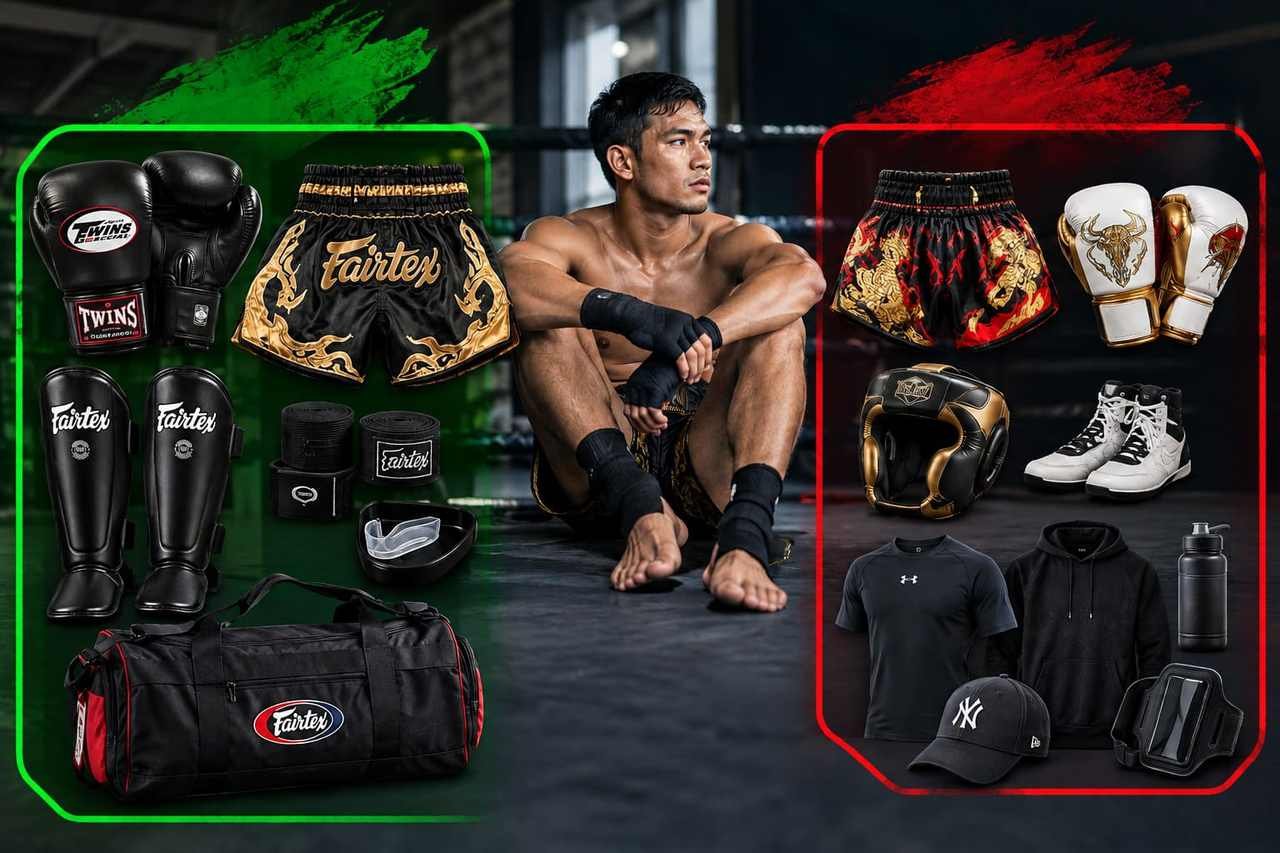
Neither of them made a terrible decision. But there is a smarter order to spend in, and most gear guides refuse to say it out loud because they earn a cut on every link. So here is the blunt version: two items deserve roughly two thirds of your money, three or four are fine at mid-range forever, and a surprising number of popular purchases exist because they photograph well.
Spend here: gloves and shin guards
These two touch your body for every minute of every class, they take every impact, and they are the only pieces where cheap gear will genuinely cost you sessions. Everything further down this page is negotiable.
Gloves
Your hands do not care about the logo. They care about foam that holds its shape and leather that does not split at the thumb crease.
Under about $60 you are almost always buying PU or vinyl over single-density foam. Brand new, that glove protects your knuckles roughly as well as a $130 one. The difference shows up at month four. The foam packs down where you land your cross, the outer material starts cracking along the fold, and the inside turns into a swamp because synthetic linings do not breathe. Sanabul, Venum’s cheaper lines, and RDX all sit here and all do the job for a beginner who is not sure they will stick with it.
Somewhere between $90 and $140 you get layered foam, real leather, and stitching that survives pad rounds. Fairtex BGV1 and Twins BGVL3 have been the default answer in gym locker rooms for over a decade for a reason: people are still using pairs they bought in 2019. Longevity is the real argument for spending more. Not power, not protection, just years.
Above roughly $180 you are paying for cosmetics, custom colorways, and marginal differences in hand shape. Plenty of good coaches disagree with me on this and will tell you a Yokkao or a Winning is worth every dollar. For a fighter with a camp coming up, sure. For someone eleven weeks into training, the money is better spent on private lessons.
One practical note that matters more than brand: get the weight right before you get the brand right. Most adults train in 14oz or 16oz, and a glove that is two sizes off will annoy you far more than a mid-tier logo. We cover that in detail in the glove weight guide.
Budget: $90 to $140 if you plan to train past six months. $50 to $65 if you are still in the trial period.
Shin guards
People underbuy here and regret it faster than with any other piece.
Cheap shin guards fail in two ways. The foam on the instep compresses until you can feel your partner’s elbow through it, and the straps stretch so the guard rotates on your leg mid round. Both are miserable. You end up stopping to fix them every ninety seconds, and stopping constantly is how you get a reputation as the person nobody wants to pair with.
The Thai-made leather guards, Fairtex SP5 and Twins SGL10 being the usual suspects, run $85 to $115 and hold their shape for years. What you are paying for is denser foam, a proper instep flap that actually covers the top of your foot, and elastic that has not given up. If you have big calves, and a lot of people who squat do, the standard Thai cut can bite. Hydra and a few of the wider Western brands make guards that solve this, and asking your kru what other people at the gym use will save you a return shipment.
Budget: $85 to $115. If your gym lends guards for the first month, use theirs and delay the purchase, but do not delay it past the point where you start clinch and kick sparring. Fit matters more than brand here, so try a pair on the leg before you commit if you can.
Mid-range is completely fine
Four items where the expensive version buys you nothing a beginner can feel.
Hand wraps. Eight to twelve dollars. Buy 180-inch semi-elastic wraps, buy three pairs so you always have a dry set, and stop thinking about it. The $30 “premium” wraps are the same cotton with a nicer label. Gel wrap inserts are a convenience item for bag work, not a replacement.
Shorts. Twenty five to forty five dollars gets you real Thai satin or nylon that survives the washing machine. Above that you are buying a design. The one thing worth knowing: Thai sizing runs brutally small. If you wear a US medium, you are looking at an XL or XXL in Thai brands, and people order wrong constantly. Measure your waist, check the brand’s own chart, and ignore the letter on the tag.
Mouthguard. A $20 to $30 boil-and-bite from Shock Doctor or SISU does the job for training. Custom dental guards run $150 to $400 and are worth it when you are actually competing or when a boil-and-bite will not stay put over braces or a bridge. Fitting it properly matters more than what you paid: reheat and refit it if it feels loose, because a guard that moves is a guard you will spit out mid round.
Bag gloves. Optional. Plenty of experienced people never own a pair and just use their sparring gloves for everything. If you hit the bag five days a week, a $35 pair keeps your good gloves from dying early. That is the entire argument.
Skip it, or at least wait
Here is where the standard beginner shopping list starts padding itself out. None of this is useless forever, but buying it in month one means paying early for a problem you do not have yet.
Headgear. A beginner is not doing the kind of sparring headgear is for, and gyms that run hard sparring usually keep a shelf of it. Buy it when your coach tells you to, which will be months from now. There is also an honest caveat worth stating: headgear reduces cuts and swelling, and it does very little for concussions. Wearing it is no license to go harder.
Elbow pads. You need these the week your gym starts letting you throw elbows in sparring. Not before. Buying them in month one is buying a $40 reminder of something you cannot do yet.
Ankle supports. Thai ankle guards are cheap, roughly $12 to $20, and genuinely useful once you have a tender ankle from checking kicks or from clinch. Bought preemptively, they just sit in the bag. Buy them the week your ankle starts complaining, not before.
Branded apparel. Every Thai brand sells tees, hoodies, and rashguards. None of it makes you better. Spend it on class fees.
Weighted gloves. I will be direct: do not buy them. Punching with added weight teaches your arm to travel a path it will never travel in the ring, it slows the retraction that keeps your chin covered, and the shoulder and elbow load adds up in a way that shows up as tendon pain around week six. Speed and power in Muay Thai come from hip rotation and from throwing thousands of correct reps, and a coach fixing your kick rotation for ten minutes will do more than a year of two-pound gloves. The same goes for weighted vests worn during pad rounds.
Reflex balls and reaction gimmicks. The $15 headband ball is fun and harmless. It also has almost nothing to do with slipping a real punch, because a ball on a string comes back on a predictable arc and a hook does not. Buy one because your kid thinks it is cool, not because you think it builds defense.
What about buying Thai brands from Thailand?
The savings are real and smaller than people claim. In Bangkok, Fairtex gloves typically go for somewhere around 2,000 to 2,600 baht, which lands near $60 to $80 at recent exchange rates. The same pair sitting on a North American retailer’s site is often $120 to $140. Shops around the Bangkok gear district, plus the brand’s own stores in Chiang Mai and Pattaya, all sit in that range and will let you try things on, which is worth more than the discount.
The catch is everything that happens after you buy. Shipping a single pair of gloves out of Thailand runs $25 to $40, duty and brokerage can add more depending on where you live, and returns are effectively impossible. Order two or three items and the math works. Order one and a domestic sale often gets you within $15 of the imported price with none of the hassle.
If you are already going to a camp, budget a bag allowance and buy on the ground. Gloves, shin guards, shorts, and a few tubs of Namman Muay for a fraction of the price at home, and you skip the sizing lottery entirely because you tried them on. Just remember the sizing rule cuts both ways: Thai gloves also fit a bit narrower in the hand compartment than most Western brands, which is a real issue for people with wide palms and one of the few things a photo cannot tell you. The brand comparison goes into who fits whom.
Two kits that actually work
Both assume you already own shoes you do not need, because Muay Thai is trained barefoot. Prices are North American retail ballpark and drift with sales.
| Item | $200 first kit | $500 version |
| Gloves | Budget synthetic 14 or 16oz, $55 | Fairtex BGV1 or Twins BGVL3 leather, $130 |
| Shin guards | Entry synthetic pair, $50 | Fairtex SP5 or Twins SGL10 leather, $105 |
| Hand wraps | Two pairs, 180-inch, $18 | Four pairs, 180-inch, $36 |
| Mouthguard | Boil-and-bite, $22 | Boil-and-bite now, custom later, $28 |
| Shorts | One pair, $30 | Two pairs, $70 |
| Bag gloves | Skip | Optional pair, $40 |
| Ankle guards | Skip | One pair, $16 |
| Gym bag with vents | $25 | $45 |
| Namman Muay or similar liniment | Skip | $10 |
| Running total | $200 | $480 |
Call the $200 build the correct kit for anyone in their first three to six months rather than a compromise. Roughly half the people reading this will quit before those cheap gloves wear out. The $500 version makes sense once you are training three or more times a week and have stopped asking yourself whether you will keep going.
Buy in this order, and one thing to do today
Wraps and a mouthguard first, because most gyms will lend you gloves for a trial class but nobody is lending you a mouthguard. Gloves second. Shorts whenever, since gym shorts work fine for a while and the short ones exist for kick clearance, not for the look. Shin guards the week before your gym expects you to have them, which is usually when partner drills start. Everything else on demand.
Today, before you open a single shopping tab: text your gym and ask two questions. Do they have loaner gloves and shin guards, and what do their regulars actually train in. A coach who watches forty people go through gear every year knows which cheap pair falls apart by March, and that answer costs nothing.
And when you do buy the nicer gloves, wear them. Nobody at a decent gym has ever thought less of a beginner for having good equipment. They think less of the person who does not wipe them down.