

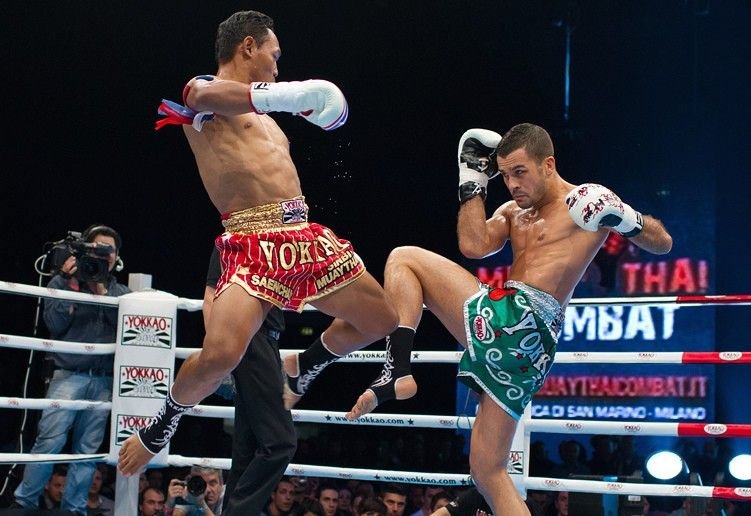
On April 19, 2026, in Maha Sarakham province, a 45-year-old southpaw threw a left high kick and put a Chinese opponent out in the first round. Maha Sarakham is where he was born. Three months later he stopped an Iranian fighter in round three at Thai Fight Songkhla, a week or so before his forty-sixth birthday, which by then was his fourth win of the calendar year.
Suphachai Saepong has been fighting for money since 1988. Most people know him as Saenchai, and most people know him from about eleven seconds of video: the cartwheel kick, the leg catch and dump, the shrug and the grin while a bigger man swings at nothing. That clip reel has done him a disservice. It turned one of the most technically complete fighters in the sport’s recorded history into a meme about showboating, and it convinced a generation of hobbyists that the fun part is the part worth copying.
The argument of this piece is simple. Every trick he throws is a timing manipulation sitting on top of an extremely conventional base, and the base is the reason the trick lands. Strip the base out and you get what most gyms get: a blue-shirt beginner cartwheeling into a knee.
Thirty baht and a week of training
He started at eight years old, after watching a friend’s older brother collect prize money at a local show. By his own telling he had trained for roughly one week before his first fight, won it on points, and was paid 30 baht, worth about a dollar at the time.
He was fighting in Bangkok by fourteen. Somluck Kamsing’s gym paid 300,000 baht for his contract, which is why he spent years billed as Saenchai Sor. Khamsing. In 1997, aged sixteen, he took the Lumpinee Stadium super flyweight title at 115 pounds. Two years later he had the bantamweight belt at 118, and the Sports Writers Association of Thailand named him Fighter of the Year for 1999. He was nineteen.
Then a detour that gets left out of most write-ups. Around 2002 he went to professional boxing, fought at featherweight under the name Suphachai Saenpong, and beat Rud 4K Kevkatchewon by unanimous decision in November 2003 for the vacant PABA interim title. He defended it in January 2004 and then walked away from boxing entirely, going back to Muay Thai with a 5-0 record and two knockouts. Five fights is a small sample and nobody should pretend otherwise, but the boxing years show up in his hand speed and in how comfortable he is fighting at punching range, which is not where a typical Thai stadium fighter wants to live.
The Lumpinee belts kept coming as he grew. Super featherweight at 130 pounds in 2005, again in 2006, then lightweight at 135 in 2010. Six stadium titles across four divisions, from 115 to 135 pounds, which is a twenty-pound climb for a man who stands 5 feet 5 inches.
The weight tax
Here is the part that made him famous inside Thailand long before YouTube got involved: he ran out of opponents.
Thai stadium matchmaking runs on gambling, and gamblers do not bet on fights nobody thinks are close. Once Saenchai was clearly better than everyone near his weight, the only way to get a card together was to hand the other man an advantage on the scale. Sometimes it was three pounds. Sometimes, in the international years, it was five to ten kilos. The most repeated version of his record holds that between 2003 and 2014 he lost only twice in Thailand at equal weight, and that every other defeat came with him giving up size. Treat that framing with some caution, because there is no clean public database of Thai stadium results from that era and the claim travels mostly through his own camp and its fans. The pattern is real even if the exact count is not verifiable.
The strangest example is a matter of public record. On July 3, 2009, at Lumpinee, he fought Petchboonchu FA Group for three rounds, then fought Sagetdao Petpayathai for the remaining two, in the same bout, and won a unanimous decision. Two elite opponents. One night. One set of scorecards.
Petchboonchu deserves his own line here, because the “unbeatable” story is nonsense. The FA Group clinch specialist beat Saenchai four times over their long series, including on points on February 7, 2014, at the very last show ever held in the old Lumpinee Stadium. A relentless muay khao fighter who could get inside and stay there was always the worst matchup for him, and everyone in Thailand knew it.
His overall record is a mess, and any article that gives you one clean number is guessing. Yokkao lists 303 wins, 52 losses and 3 draws. BJJ Fanatics lists 303-41-5. Wikipedia’s fight table currently totals 330 wins, 49 losses and 7 draws, and keeps growing every few months. The gap between those counts is bigger than most fighters’ entire careers, which tells you something honest about how Thai records were kept in the 1990s.
So what is he actually doing?
Strip away the flourishes and Saenchai is a textbook classic muay femur: a technician who wins by reading, timing, and scoring cleanly rather than by breaking anyone. What sets him apart is that he weaponized the reading itself.
Feints that cost nothing
Watch him for one round and count how often he starts a kick and does not finish it. The lead-leg fake is his metronome. He lifts the knee, the opponent’s guard or check reacts, and by the time the reaction is committed he has already shuffled to a new angle or switched which foot is forward. He is a southpaw, so his power side already sits outside the orthodox opponent’s lead foot, and the fake shifts that geometry again before the other man can re-solve it.
Stance switching is the same idea in bigger form. Every time he changes lead, the opponent has to re-map which weapon is loaded, which side to check, and where the sweep is coming from. Most fighters switch stances to set up one strike. He switches to erase the other man’s read and force him to start over, and he does it in the middle of exchanges, when his opponent has the least spare attention to spend on re-solving the problem.
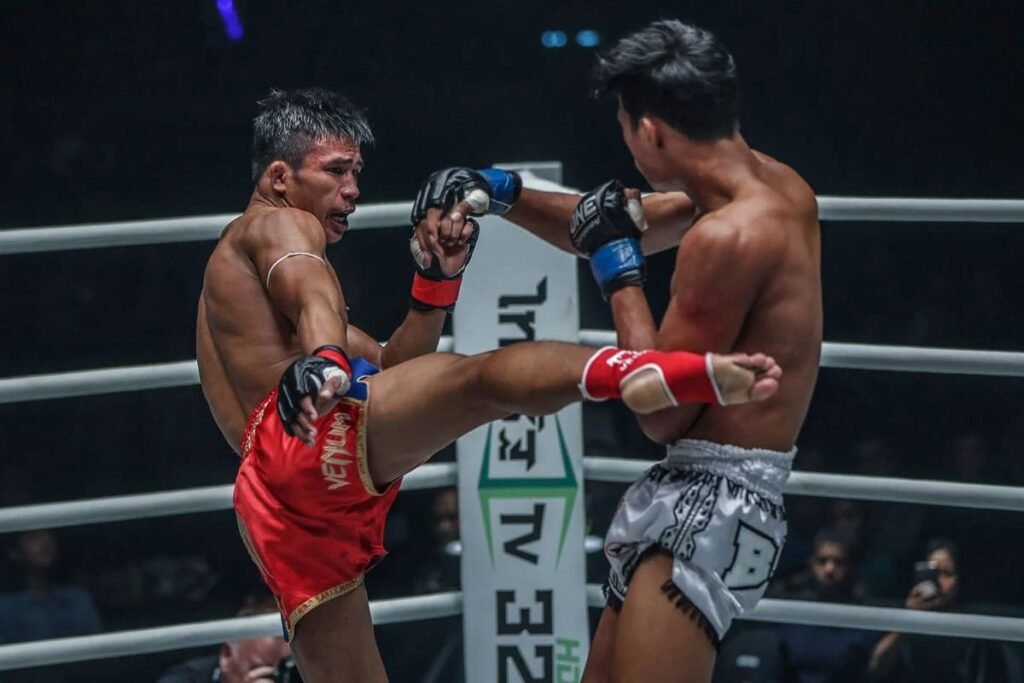
None of that works without balance, and balance is where the boring hours live. He can catch a kick, hold it, walk his opponent two steps, and dump him without ever losing his own base. He lands from his own kicks in stance rather than stumbling out of them. That is unglamorous, single-leg, thousands-of-repetitions work, and it is the actual difference between him and the guy in your gym doing the same movements.
About that cartwheel kick
Honest answer: it is the least important thing he does.
The cartwheel kick barely damages anyone, and under Thai stadium criteria it scores poorly compared to a clean body kick, so it is not winning him rounds. What it does is buy attention. It resets an opponent’s expectations about what is possible from an unexpected line, it plays to a crowd, and against a fighter who has already been made to look foolish twice, it works as psychological pressure. Long-time fans who love him say this openly. Plenty of North American amateur rulesets ban cartwheel kicks outright, so before you try one in a smoker, read your sanctioning body’s rules rather than assuming.
His head movement raises the same flag. Slipping and rolling is dangerous in a sport with kicks and knees, and Muay Thai coaches spend a lot of energy stopping students from ducking into a shin. He gets away with it because his footwork resets his base after every movement. A beginner who copies the slipping without the footwork is building a habit that will get his head kicked off.
The second career
By 2010 he was fighting abroad constantly, and the international run produced most of the footage westerners actually watched. He knocked out Tetsuya Yamato with a left high kick in the first round in Los Angeles on March 14, 2010, for a world lightweight title. He outpointed Kevin Ross in Anaheim in August 2011. He fought Liam Harrison three times and won all three on points, the last in Macau in December 2012, and Harrison’s own account of those fights is worth more than any highlight reel: he describes cutting Saenchai’s eye, landing his best shots, and and describing him afterwards as one of the toughest men he had ever fought, technique aside. They ended up friends.
He also lost, which the mythology tends to skip. A seventeen-year-old named Yodwicha Por Boonsit outpointed him at Lumpinee in May 2013. Petchboonchu got him again in February 2014.
Since late 2014 he has fought almost exclusively for Thai Fight, against foreign opponents, on a streak that runs into the dozens. He has taken King’s Cup titles at 67 kg and 70 kg, though sources cannot agree whether the total is five or six. This is where the honest caveat belongs: the level of opposition in the exhibition era is nowhere near stadium Muay Thai, a lot of his opponents have thin professional résumés, and a good chunk of the fan base treats the streak as entertainment rather than evidence. That criticism is fair. It also does not retroactively erase what he did between 1997 and 2014.
Five things worth stealing
- The uncommitted lead-leg fake. Next session, shadowbox three rounds where every third kick is started and abandoned. Then take it into light sparring and count how many times your partner reacts. That count is the technique.
- Landing in stance. After every kick on the bag, freeze for one second on the landing. If you have to hop or reach to recover, the kick was too big for your base.
- The kick catch and walk. Legal, high-percentage, and undertrained in most western gyms. Catch, take two steps in the direction he is already falling, release.
- Fighting at punching range without panicking. His boxing detour shows up here. Most Muay Thai hobbyists either kick or clinch, and the space between is where he lives.
- Changing the problem, not the answer. When something is not working, he changes stance, level, or angle before he changes strikes.
What not to steal: the low hands, the head slipping, the taunting, and the cartwheel. All four are load-bearing for him and pure liability for you.
Where the imitation breaks down
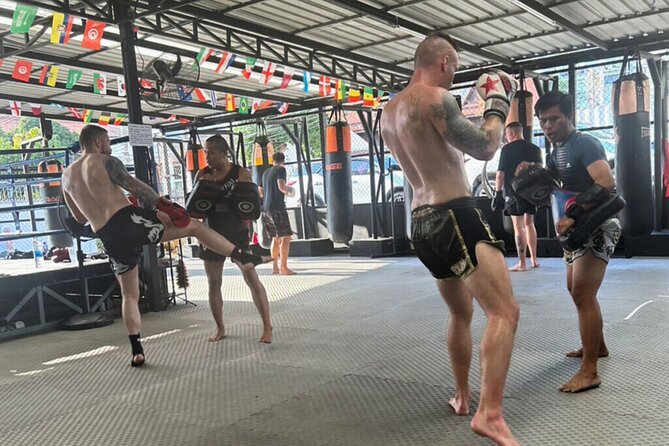
The gym version of Saenchai fails for a boring reason. He is not improvising. Everything he throws is a variation on a fundamental he has drilled since 1988, deployed at a moment he has already earned by making his opponent commit to a reaction. The hobbyist copies the shape of the movement and skips the reaction, so the movement arrives at a random time against a man who is not fooled, and it looks exactly as ridiculous as it is.
If you want to argue about where he sits in the greatest-of-all-time debates, fine, that argument never ends and Samart fans will never concede it. The more useful thing to take from him is not a ranking. Watch a full fight instead of a highlight compilation, ignore the cartwheel entirely, and count the feints. There will be more of them than you expect, and that is the whole magic trick.

One Comment