
Here’s what actually goes in the bag. No filler, no “maybe you’ll need it someday” padding, just the stuff that ends up in your hands three times a week whether you’re a beginner or a fighter with a bout date circled on the calendar. The list grows as you get more serious about training, so this breaks into three tiers. Start with the first one.
The Beginner Seven
If you walked into your first class tomorrow with nothing but the items below stuffed into an old backpack, you’d be completely fine. Seven items, nothing more.
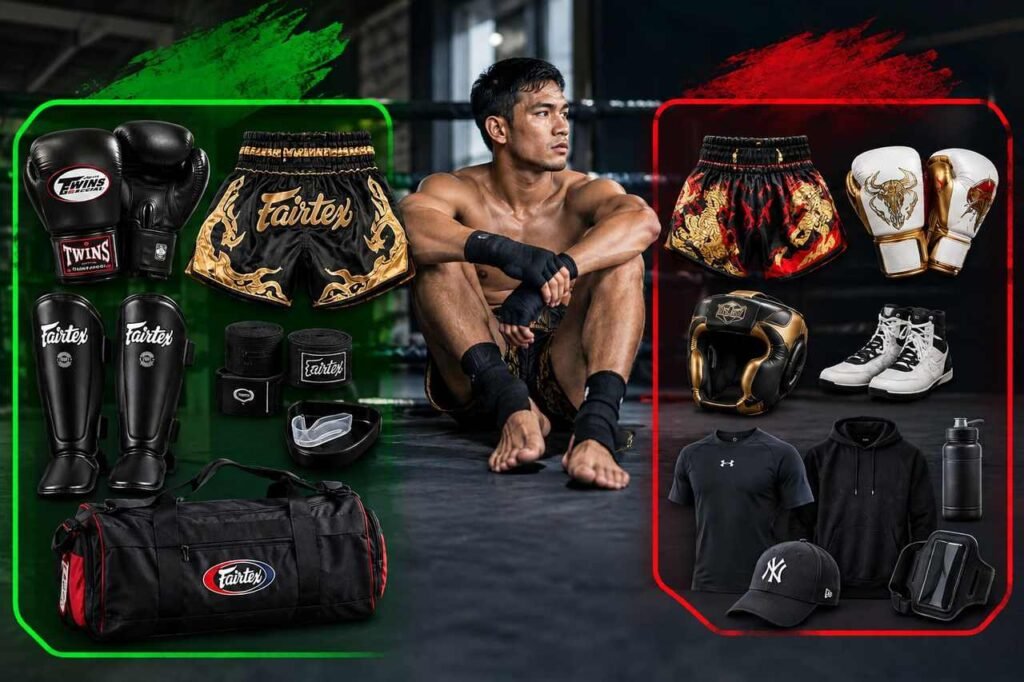
- Gloves – your own pair, sized to your hand, broken in a little so they don’t feel like bricks.
- Hand wraps – two pairs minimum, because one pair is always drying out from last session.
- A mouthguard – even for pad work. Elbows show up when you least expect them.
- Muay Thai shorts – loose through the hips, since kicks don’t work in anything tight.
- A change of shirt – the one you trained in will be soaked by round three.
- A towel – small gym towel, not a bath towel. You just need to wipe your face between rounds.
- Water – a full bottle, refillable if your gym has a tap.
That’s the whole starter kit. Everything else on this list gets added once training stops being occasional and starts being a habit.
The Regular’s Kit
Once you’re training four or five times a week, the beginner seven stops covering it, and you start noticing gaps every time you pack for a session that runs longer or hits harder than a typical class. Here’s what gets added to the bag around month three or four.
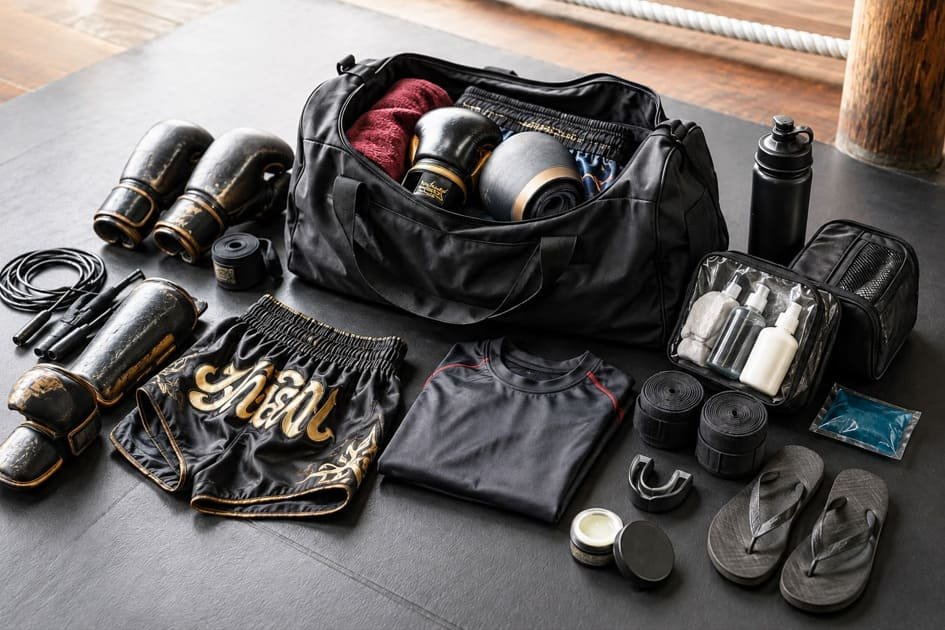
- Shin guards for sparring days, so your shins survive the learning curve on checking kicks.
- A jump rope. Every gym has spares, but yours is always available and always the right length.
- Tape for fingers, wrists, whatever tweaked itself last week.
- A warming liniment rubbed into the legs before a hard session. Thai fighters have used versions of this for decades, and it genuinely helps loosen tight muscle before kicking drills.
- A spare change of underwear. Not glamorous. Necessary after a two-hour session in July heat.
- A separate bag for wet items, so your soaked wraps and shirt don’t sit against your dry clothes on the drive home.
This is the bag of someone who trains, not someone who dabbles. It’s heavier, it smells like liniment, and it never fully empties out between sessions.
The Fighter’s Bag
Fight camp changes the math again. A few weeks out from a bout, you’re not just packing for training anymore. You’re packing for a day where everything has to work on the first try.
- Elastic wraps in addition to your regular wraps, since fights often call for a specific wrapping style your commission or promotion requires.
- Ice packs, sealed and ready, for anything that swells during fight week sparring or on fight night itself.
- A snack that won’t upset your stomach, packed for the long stretch between weigh-in and the actual fight.
- Weigh-in documents – ID, medical clearance, whatever paperwork your promotion requires. Losing these costs you more than losing a round.
Everything from the first two tiers still rides along too, since this section only adds on top of it. A fighter’s bag on fight week is genuinely the heaviest version of the bag, and that’s fine. It’s supposed to be.
Hygiene Hacks That Save Your Gear
A gym bag that never gets organized turns into a health problem fast. Wet wraps sitting against dry gloves for two days breed bacteria, and gear that stays damp breaks down faster than gear that dries properly between sessions.
A few habits fix most of this:
- Use a mesh bag for wraps and hand wraps specifically. Air moves through mesh even when zipped shut, which a plastic bag never allows.
- Keep wet and dry items in separate compartments, always. Wet gear goes in its own pouch the moment you take it off, not after you get home.
- Drop glove deodorizer inserts into your gloves the second practice ends, not the next morning. The longer damp gloves sit closed up, the worse the smell gets, and by month two it stops coming out no matter what you spray on them.
None of this is complicated. It’s just consistent, and consistency is the whole difference between gear that lasts two years and gear that gets thrown out after six months.
Choosing the Bag Itself
Skip the brand names and look at the mesh panels instead. A bag with real ventilation, side vents, a breathable bottom, a separate wet compartment, will keep your gear from turning into a science experiment far better than a bag with a famous logo and zero airflow. Ventilation does more for your gear’s lifespan than anything printed on the outside.
Size matters too, but less than people think. You want enough room for the fighter-tier list above even if you’re only at regular-training level right now, because gear accumulates and you’ll be glad you bought room to grow into. A bag that’s stuffed tight on day one will be unusable by month six.
Beyond that, the details are personal. Some people want a shoe compartment. Some want a bag that also works as a duffel for weekend trips. None of that changes the core requirement: airflow first, everything else second.
If a Thailand training trip is somewhere down the line, the site’s free Muay Thai Travel Handbook covers what to bring for that specific situation, separate from the everyday gym bag.