
How long does a Muay Thai fight actually last? A traditional professional bout in Thailand runs five rounds of three minutes each, separated by two-minute rest periods, which adds up to roughly 23 minutes of scheduled time even though very few fights go the full distance. Newer promotions have started cutting that number down, and the reasons say a lot about where the sport is headed.
Quick Answer
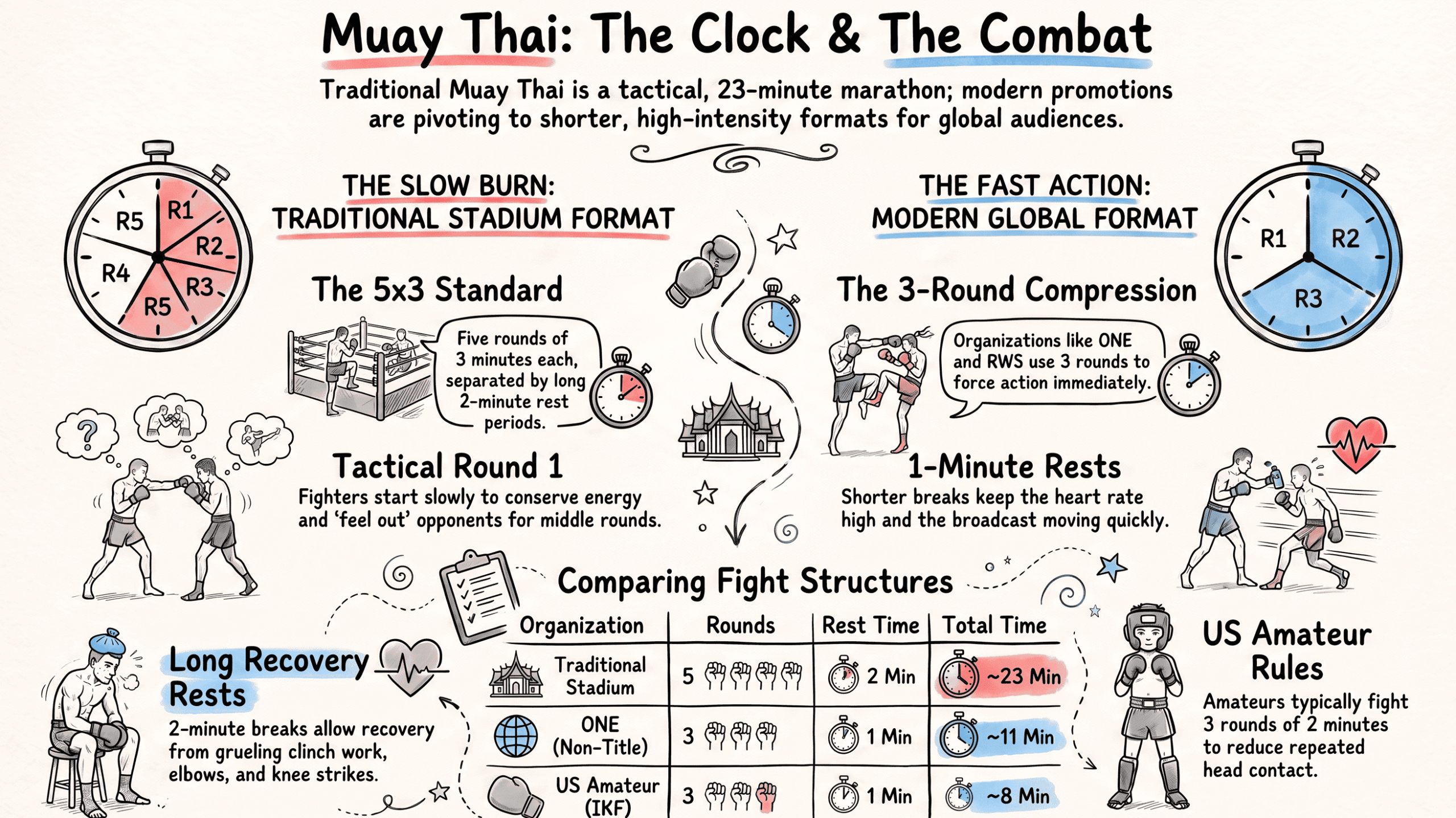
Five rounds, three minutes apiece, two minutes of rest between them. That is the format used in Bangkok’s biggest stadiums and by most sanctioning bodies that follow the traditional ruleset. A first-time viewer tuning into a stream should expect a fight card to move slower than a boxing card, round for round, because the breaks alone eat up nearly as much clock time as the action does.
The Traditional 5-Round Format
Stadium Muay Thai in Thailand, along with most international federations that follow the traditional ruleset, uses five three-minute rounds. Between each round, fighters get two full minutes to sit down, get worked on by their corner, and reset. Compare that to boxing, where the standard rest is just one minute, and the gap starts to look less like a quirk and more like a design choice built around how Muay Thai differs from boxing in the first place.
Two things explain it. Muay Thai fighters absorb clinch work, knee strikes, and elbows on top of the punches and kicks that boxing already accounts for, so recovery takes longer. There is also a scoring reason. Traditional Thai judging weighs the fight as a whole rather than tallying each round separately, and the third and fourth rounds typically carry the most weight on the scorecards. A longer break lets fighters and corners recalibrate strategy before the rounds that actually decide the fight.
Why Round 1 Barely Looks Like a Fight
Anyone watching a Thailand stadium bout for the first time notices it fast: round one looks tentative, almost bored. Fighters circle, feel out range, and throw far fewer strikes than they will two rounds later. Nerves do not explain it, and neither does a mismatch in skill. The real reason is pacing, one of the most distinctive features of Thai fight structure that almost nothing written for Western audiences bothers to explain.
Traditional scoring rewards damage and control across the whole fight, with the middle rounds weighted most heavily. A fighter who blows through his energy in round one gains almost nothing for it and risks fading exactly when the judges start paying closer attention. Add in the wai kru ram muay, the pre-fight dance ritual that already taxes a fighter’s legs and lungs before the bell even rings, and round one becomes a recovery period as much as a feeling-out process. Bettors ringside know this too. Odds in Thai stadiums shift constantly during a fight, and a slow start is often read as calculation rather than weakness.
Newer 3-Round Formats Are Changing the Sport
That pacing works for a culture raised on it. It does not always work for a streaming audience with a remote in hand. Over the last several years, the organizations pushing Muay Thai to global television and app-based audiences have trimmed the format to hold attention from the opening bell.
ONE Championship runs non-title Muay Thai bouts over three rounds of three minutes, with one-minute rest periods between rounds. Title fights stretch to five rounds but keep the same one-minute breaks rather than the traditional two. Rajadamnern World Series, the newer promotion built around Bangkok’s oldest stadium, runs regular bouts over three rounds as well, reserving five-round formats for its championship contests. Both approaches force action earlier. There is no slow first round to hide in when the fight is only three rounds long.
Fight Duration by Organization
| Organization / Format | Rounds | Round Length | Rest Between Rounds | Total Scheduled Time |
| Traditional Thailand stadium (professional) | 5 | 3 minutes | 2 minutes | ~23 minutes |
| ONE Championship (non-title) | 3 | 3 minutes | 1 minute | ~11 minutes |
| ONE Championship (title fight) | 5 | 3 minutes | 1 minute | ~19 minutes |
| Rajadamnern World Series (regular card) | 3 | 3 minutes | Not standardized publicly | ~9-11 minutes |
| Rajadamnern World Series (title fight) | 5 | 3 minutes | Not standardized publicly | ~15-19 minutes |
| US amateur (IKF / USA Muaythai, regular) | 3 | 2 minutes | 1 minute | ~8 minutes |
| US amateur (IKF, title fight) | 5 | 2 minutes | 1 minute | ~14 minutes |
These are scheduled totals, not actual fight length. A knockout, a doctor stoppage, or a lopsided final round can end things well before the clock runs out.
How Long Are Amateur Fights in the US?
First-time spectators at a local Muay Thai card in the United States will usually see something shorter and faster than what streams out of Bangkok. Amateur bouts sanctioned under IKF or USA Muaythai rules typically run three rounds of two minutes, with one-minute rest periods. Title bouts in these amateur systems stretch to five rounds, still at two minutes each. Amateur commissions generally favor reduced exposure to repeated head contact over multiple full-length rounds, especially for newer competitors still building conditioning.
Anyone stepping into an amateur ring for the first fight of their career should expect something closer to eight minutes of actual round time than the twenty-plus minutes a professional Thailand bout can run. Scoring still typically follows some version of the 10-point must system used across most Muay Thai judging, just compressed into fewer rounds.
FAQ
How long is a professional Muay Thai fight? A traditional professional bout runs five three-minute rounds with two-minute rests between them, for roughly 23 minutes of scheduled time. Actual fight length is often shorter if there is a stoppage.
Why are Muay Thai rounds shorter in some organizations? Promotions built for streaming and television, such as ONE Championship and Rajadamnern World Series, use three rounds instead of five to keep the pace tighter for viewers who did not grow up watching the traditional format.
Why is the rest period in Muay Thai longer than in boxing? Traditional Muay Thai gives fighters two minutes between rounds instead of boxing’s one minute, mainly because clinch work, knees, and elbows demand more recovery time than punches alone, and because the sport’s scoring tradition puts extra weight on the middle rounds.
Is round one of a Muay Thai fight always slow? In traditional Thai stadium bouts, yes, more often than not. Fighters use it to read their opponent and conserve energy for the middle rounds, which typically matter most on the scorecards. Three-round formats compress this pattern since there is less fight left to save energy for.
How long do amateur Muay Thai fights last in the US? Most amateur bouts run three two-minute rounds with one-minute rests, adding up to about eight minutes of round time. Title fights in amateur competition often extend to five rounds under the same two-minute structure.