

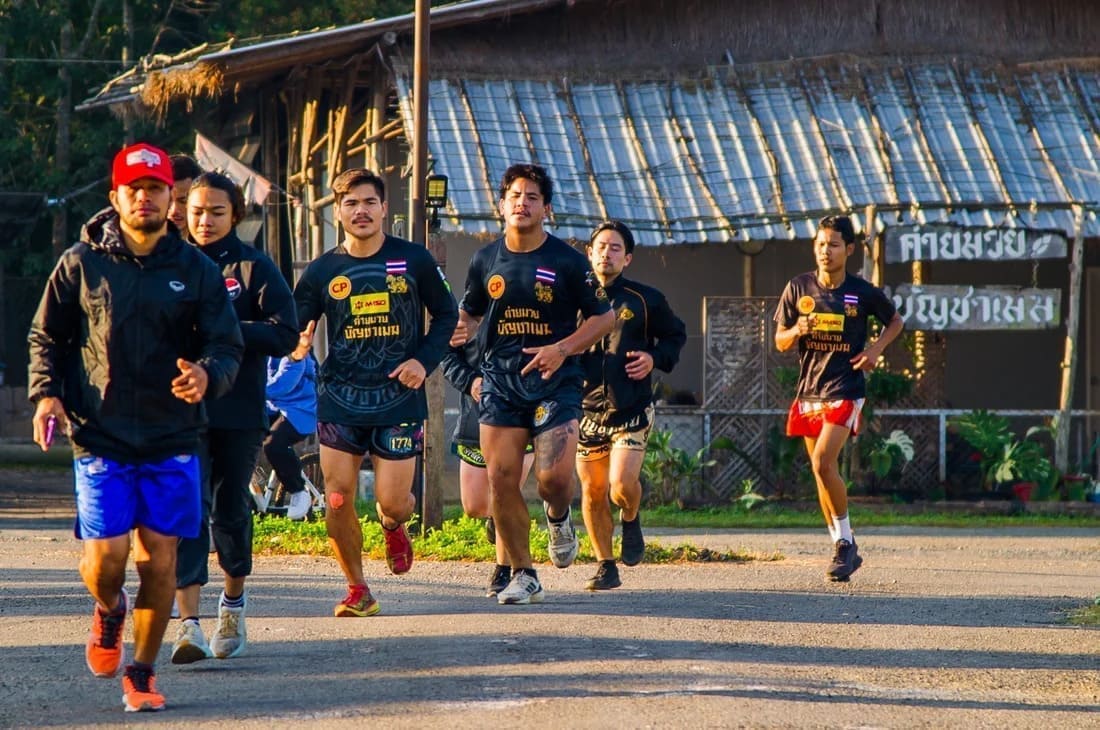
The 6 AM Run: A Thai Camp Ritual
The gate opens before the sun does. A dog barks somewhere down the soi, a scooter sputters past with a vendor already setting up for the day, and a line of fighters steps out onto the road in worn-out trainers and hoodies zipped to the chin. Most Western gyms haven’t even opened their doors yet. Half the country is still asleep. In a Thai camp, the day already has an hour behind it.
They run in a loose pack, sometimes talking, sometimes not, past rice paddies or along a coastal road depending on the province. Six, eight, sometimes ten kilometers, at a pace slow enough to hold a conversation but long enough that legs feel it by kilometer five. Nobody sprints this. Nobody times it against a watch, not usually. It’s just what happens every morning, the way brushing your teeth happens, no debate required.
Western fighters who train at these camps for the first time tend to ask the same question around day three: why? The pads work. The sparring works. So what does a slow jog through the countryside actually add to a fighter who already trains twice a day?
What Roadwork Actually Builds
Start with the obvious part. A five-round Muay Thai fight, even at amateur level, asks the body to sustain output for fifteen minutes with only sixty seconds of rest between rounds. That kind of pace needs an aerobic engine underneath it, and long, steady running is still one of the cheapest ways to build one. Slow-distance work increases capillary density in the legs, strengthens the heart’s stroke volume, and raises the point at which lactic acid starts to pile up faster than the body can clear it. None of that shows up on a highlight reel, but it decides who’s still moving well in round four.
Then there’s the legs themselves. Roadwork conditions the exact muscles that absorb checked kicks and hold a stance through five rounds of pressure. Tired legs buckle. Trained ones don’t, or at least not as fast.
The third piece gets talked about less, but Thai trainers rate it just as highly: discipline. Nobody has to tell a fighter to get up at 5:30. Nobody has to remind them to run in the rain, or three weeks out from a fight when the motivation has already worn thin. That’s a rehearsal for the exact mental state a fighter needs in round four, when the legs are heavy and quitting would be so much easier than the alternative.
Tradition plays its part too. Generations of fighters ran before dawn because that’s when camps trained, because the heat later in the day makes distance running miserable, and because it’s simply how it’s always been done. Not every habit needs a modern justification to survive.
A Day in a Thai Camp
The exact schedule shifts from camp to camp, but the shape of the day stays remarkably consistent across the country. Two training sessions, one long run, and hours of rest packed in between.
| Time | Activity |
| 5:30 AM | Wake up, light stretch, sometimes coffee |
| 6:00-7:30 AM | Roadwork, 5-6 miles (8-10km) |
| 7:30-8:30 AM | Cool down, breakfast, rest |
| 9:30 AM | Skipping, shadowboxing, calisthenics |
| 10:00 AM-12:00 PM | Pad work, bag rounds, clinch |
| 1:00-3:00 PM | Lunch and a nap, usually a long one |
| 4:00-6:00 PM | Second session: technique, sparring, conditioning |
| 6:30 PM | Dinner |
| 9:00-10:00 PM | Lights out |
The rest isn’t laziness. It’s the part that lets the body absorb everything the morning run and the afternoon pads just did to it. Skip the rest and the running stops helping. It just wears a fighter down faster than the pads ever could.
How Much Should You Actually Run
Here’s the part most Western amateurs get wrong. They either skip roadwork completely because cardio isn’t fighting, or they try to copy the Thai schedule exactly and burn out within two weeks. A full-time fighter’s recovery capacity isn’t available to someone working a nine-to-five and training three evenings a week, and pretending otherwise is how shin splints happen.
A realistic target for a Western amateur training three or four times a week looks like this: two to three steady runs, 20 to 40 minutes each, at a pace where a full sentence still comes out in one breath. Add one interval session on top of that, not instead of it. Running six days a week on a full training schedule tends to produce burnt-out adrenals and cranky knees rather than a bigger gas tank.
Anyone also lifting heavy or sparring hard should lean toward the lower end of that range. Volume stacks. A full-time camp fighter with nothing else on the schedule can absorb ten kilometers a day. Someone squeezing training around a job usually can’t, and trying anyway just delays the next hard session.
Interval Alternatives
Steady running isn’t the only road to a bigger tank, and for some bodies it isn’t even the best one. Jump rope in three-minute rounds mimics fight pace almost exactly, hits the calves and shoulders, and takes a fraction of the time a long run does.
Hill sprints work differently. Eight to twelve reps of 100 to 200 meters, with brief rest between them, build the anaerobic capacity a five-round fight leans on hardest in the last minute of a hard round, when the aerobic system alone isn’t enough anymore.
The assault bike deserves a mention too, mostly because it’s miserable in a useful way. Twenty seconds hard, forty seconds easy, repeated for eight to ten rounds. It hits the same energy systems a fight does, minus the joint pounding of running on pavement every single day.
None of these replace roadwork outright. They supplement it, and for someone with bad knees or limited time, they can carry most of the load a long run would otherwise handle.
Building a Gas Tank Without 10K Runs
Not everyone needs to run ten kilometers to fight well. The full-body demands of Muay Thai training already do more conditioning work than most other sports manage in a single hour, and pad rounds, clinch work, and bag rounds all tax the same aerobic system a run does, just less evenly.
The fighters who build a real gas tank without matching a Thai camp’s mileage tend to share three habits. Consistency beats volume. At least one hard interval session finds its way into the week. Sleep gets treated as part of training, not an afterthought squeezed in around it. A single brutal session followed by four days of nothing builds far less than three moderate ones spread evenly across the week.
Roadwork also happens to be one of the more reliable ways to burn through stubborn body fat while building that base, which is part of why it shows up so often in guides on how Muay Thai helps with weight loss. The conditioning and the fat loss come from the same engine, running on the same morning schedule.
Skip the run entirely and something usually gives out by round three, legs or lungs or focus. Copy the Thai schedule exactly without a fighter’s recovery capacity, and something gives out even sooner. The answer sits in the middle, closer to two or three honest efforts a week than to a daily ten-kilometer grind through the dark.
FAQ
Do you have to run to get good at Muay Thai? No, but some form of steady-state conditioning helps almost every fighter. Pad work and sparring build fitness too, just less directly. A weekly run or two fills the gap most gym-only training leaves behind.
Is it better to run before or after training? Running first thing works well for building an aerobic base without the fatigue from a training session already in the legs. Running after an evening session is fine too; the main rule is not to run so hard it wrecks tomorrow’s pad work.
How long before I notice better cardio in sparring? Most amateurs feel a real difference after four to six weeks of consistent running, two or three times a week. The legs feel it first; breathing catches up a few weeks after that.
One Comment