
Kru and sensei are not the same word wearing different clothes. Western students often assume every martial arts culture has one interchangeable title for “teacher,” borrowed loosely from Japanese conventions, and drop “kru” or “ajarn” into conversation the way they’d say “coach.” In Thai Muay Thai culture, the distinction is specific, it carries weight, and getting it wrong in front of a Thai instructor reads as careless rather than charming.
Kru vs Ajarn: Who’s Who
Kru simply means teacher. Any instructor running a class, correcting a stance, or holding pads for a beginner can be addressed as kru, and in most gyms that’s the correct, respectful default. It doesn’t require decades of experience or a formal ceremony. A twenty-five-year-old who teaches the morning class is still kru to the students in that class.
Ajarn sits higher. The word translates closer to “professor” or “master teacher,” and Thai society uses it well outside combat sports, for university lecturers and revered scholars alike. In a Muay Thai context, ajarn is reserved for someone with real seniority: decades in the sport, a lineage of fighters they trained personally, often their own camp or system built over a career. Nobody self-appoints as ajarn. The title accumulates through years of recognition from peers and students, not through a certificate or a belt test.
The mistake foreigners make is treating these as synonyms, or worse, calling a young pad holder “ajarn” as a compliment. It isn’t a compliment. It flattens a hierarchy that Thai fighters take seriously, and it can embarrass the person being addressed that way in front of their own teachers.
The Wai: Doing It Right
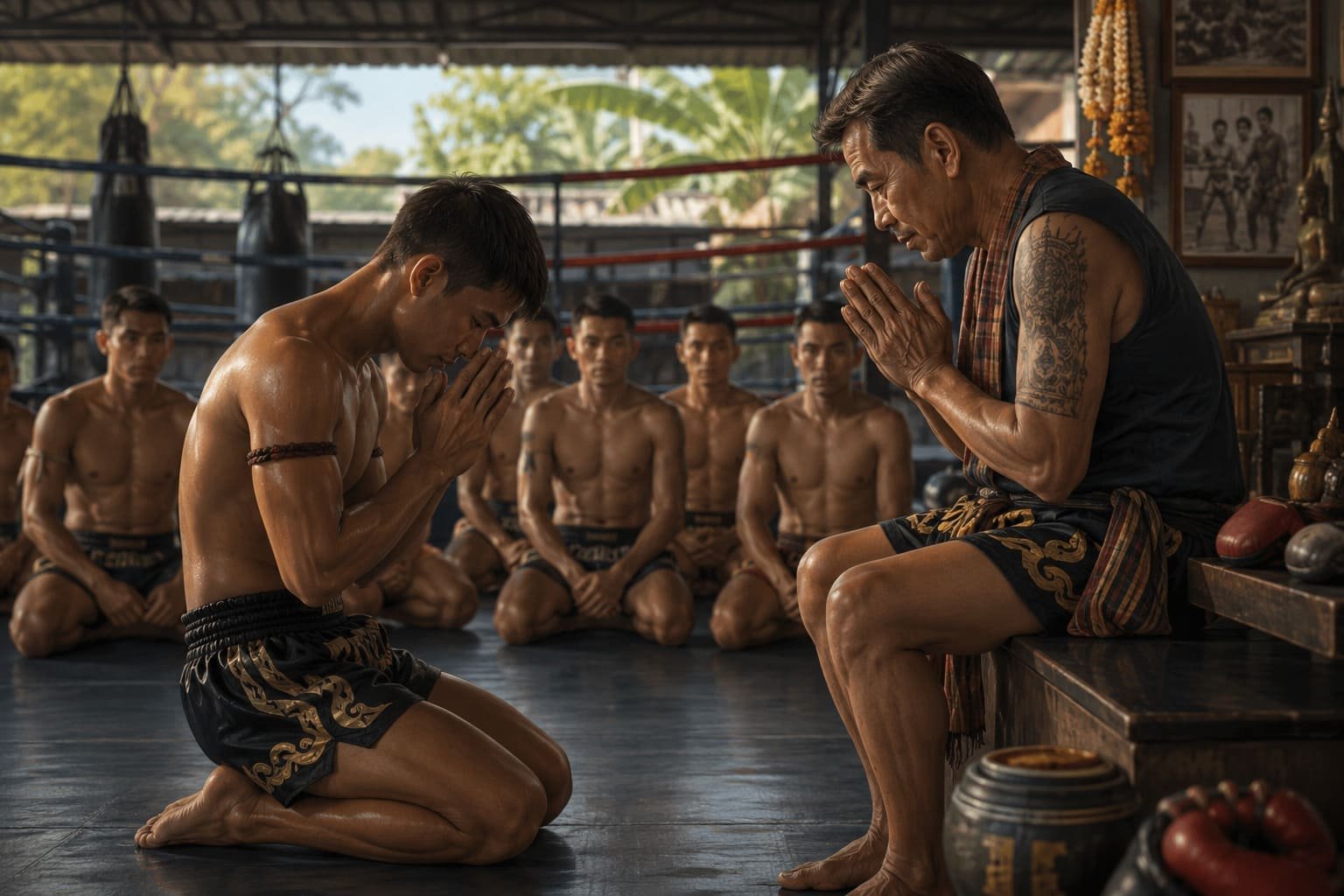
The wai is the pressed-palms gesture that greets, thanks, and shows deference, and getting the mechanics right matters more than most visitors expect. Hands come together at chest height, fingertips pointing up toward the chin or nose, with a slight bow of the head toward the fingertips. It is not a prayer pose held at the forehead unless the context calls for it, and it is not a quick clap-like gesture rushed through in half a second.
Height and timing carry meaning. The junior person, meaning the student, wais first. They hold the position a beat longer than the senior person returning it. A kru or ajarn may return the gesture with a smaller nod, a lower hand position, or sometimes just a warm acknowledgment without a full wai at all, and that’s not rudeness. Status runs in one direction here. The senior person receiving a wai has no obligation to match its intensity, and expecting them to is itself a misunderstanding of what the gesture is doing.
New students often overcorrect out of nervousness, waiing everyone at every interaction until it loses meaning. Save it for greetings, thanks, and moments of genuine respect, like entering the gym for the first time each day or after a private lesson ends.
Why Are Teachers Sacred in Thai Culture?
Reverence for teachers in Thailand runs far deeper than the gym floor. Thai culture places teachers, called khru in the older Sanskrit-derived spelling, among the figures owed the deepest respect a person can show, alongside parents, monks, and the monarchy. This isn’t a Muay Thai invention. It reflects a broader Buddhist and cultural framework where knowledge transmitted from teacher to student is treated as a kind of debt, one that shapes how a person carries themselves for life.
That framework explains a lot of what looks, to outsiders, like formality for its own sake. A Thai student doesn’t just learn technique from a kru. They inherit a piece of that teacher’s lineage, their reputation, their years of accumulated knowledge, and the debt runs both directions: the teacher takes responsibility for what the student becomes. Muay Thai gyms didn’t invent this dynamic. They absorbed it from the wider culture and applied it to pad work and clinch drills the same way a Thai classroom applies it to arithmetic.
Foreigners who grasp this stop seeing gym etiquette as arbitrary rules and start seeing it as a small, specific expression of something much larger. That shift changes how the rules land.
The Unwritten Gym Hierarchy
Walk into a working Thai camp and nobody hands out an org chart, but the hierarchy is visible within a day. Senior fighters, meaning the ones who’ve trained there the longest or fought the most, get first pick of pad holders and first access to the ring for combinations work. Newer arrivals wait, and pushing ahead of that order draws quiet correction fast.
Pad-holding itself follows rank. The most experienced kru usually works with the gym’s top fighters, saving the sharpest feedback for students who’ve earned the reps to use it. Assistant trainers and senior students handle beginners, which is not a demotion, it’s how skill gets transmitted downward through the camp. Cleaning duties, sweeping the mats, wiping down the bags, tend to fall to the newest students or those living at the gym full time, and taking that task seriously, rather than treating it as beneath them, is one of the fastest ways a foreign student earns trust.
None of this gets posted on a wall. It’s absorbed by watching, and the students who ask before assuming tend to fit in faster than the ones who guess.
Ten Rules for Training in Thailand
A short list covers most of what trips up a first-time visitor to a Thai gym, and running through it before the first class beats learning it by correction in front of everyone.
- Shoes come off before stepping onto the mats or ring area, no exceptions.
- Never touch anyone’s head, including children’s, even in a friendly gesture. The head is considered the most sacred part of the body.
- Don’t point your feet at people, at Buddha images, or at the ring itself. Feet are the lowest, least respected part of the body in this framework.
- Never step over someone sitting or lying down, and never step over gear like gloves, wraps, or pads left on the floor. Walk around instead.
- Wai the kru when arriving for the first class of the day, not for every passing interaction.
- If a kru offers to hold pads or corrects your stance, don’t wave it off or argue the point mid-drill.
- Don’t turn your back on the ring during a ceremony or a fight taking place in it, if avoidable.
- Dress modestly walking to and from the gym, particularly in more traditional or rural areas.
- Address the kru as kru, not by first name, unless they’ve specifically invited that familiarity.
- Stay humble about rank, belts, or experience from back home. None of it transfers, and announcing it reads as arrogance rather than credentials.
Respect Culture in Western Gyms
None of this translates cleanly to a strip-mall gym in Ohio or a Muay Thai club in Toronto, and pretending otherwise causes its own problems. Calling an American or Canadian coach “kru” or “ajarn” when they never asked for it, never trained under that framework, and don’t hold that title in their own lineage isn’t respect. It’s costume. It borrows the aesthetics of a serious cultural practice without the substance behind it, and Thai instructors who’ve seen this happen tend to find it more awkward than flattering.
The honest approach is simpler than the performance. Ask the coach what they want to be called, and use that. Some Western coaches who trained extensively in Thailand and earned real standing there do use kru, and that’s their call to make, not a title students confer unprompted. Others go by first names, “Coach,” or nothing formal at all, and that’s just as legitimate a gym culture.
What actually carries over, and matters more than any title, is the behavior underneath it: showing up on time, not arguing with corrections, taking your turn on the pads without complaint, and treating the people who teach you as people who’ve earned it. That’s the part of Thai gym culture worth keeping, regardless of what anyone calls the person running the class.