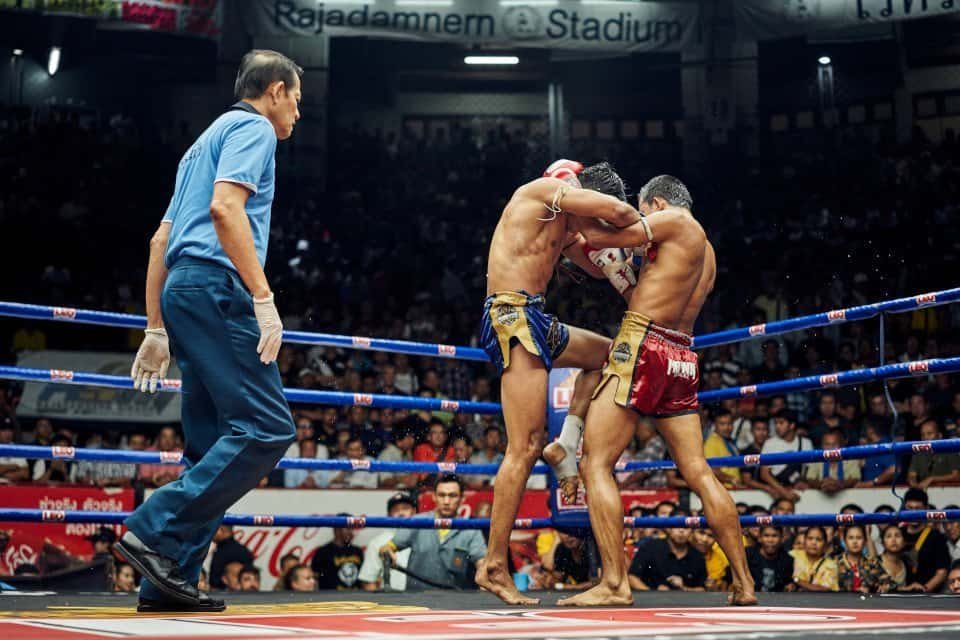
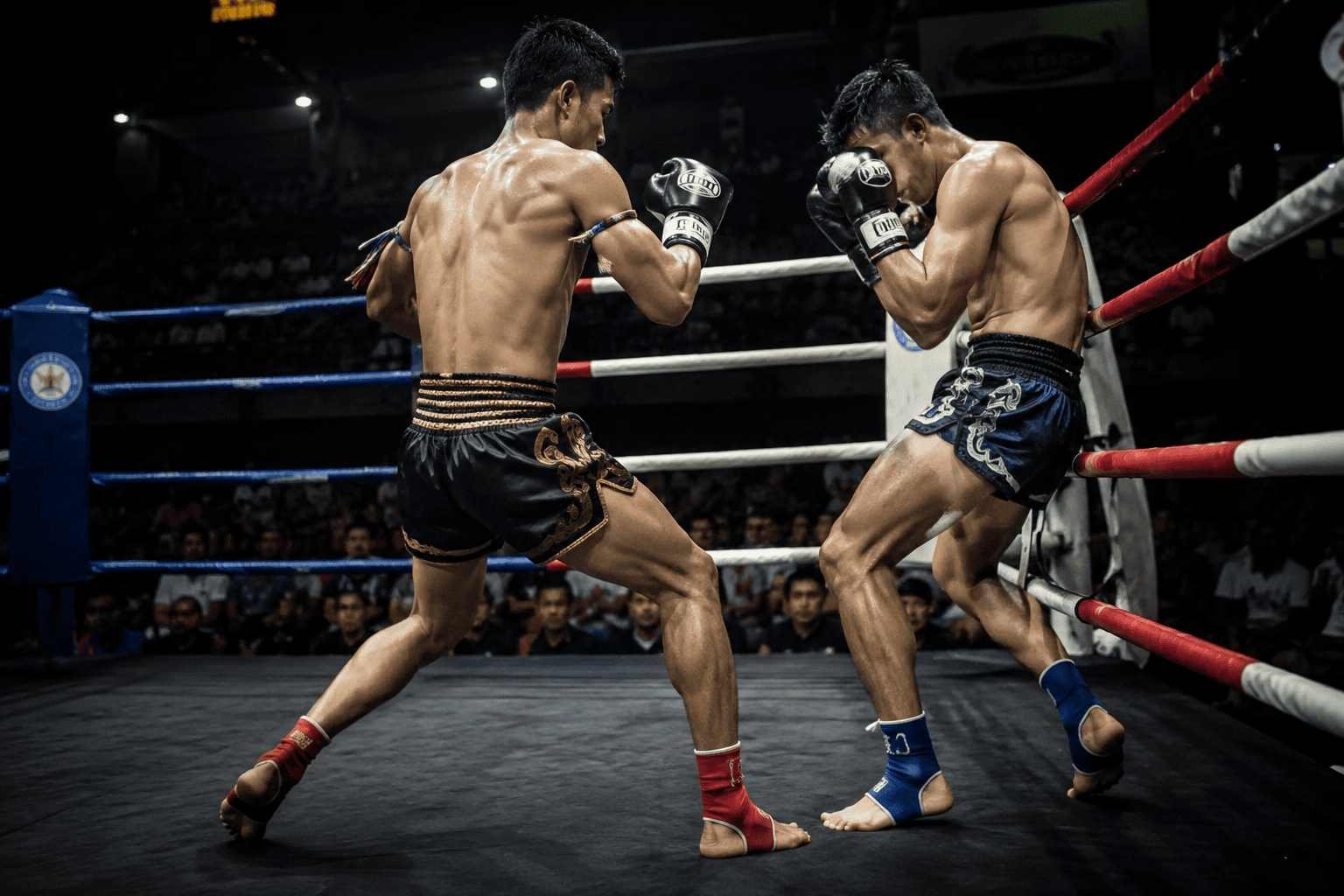
Third round at Rajadamnern, and the noise changes before anything lands. A fighter’s shoulder blades brush the top rope for half a second, and the tiers of gamblers behind the far corner catch it instantly, odds shifting mid-shout. Nothing has actually happened. No knockdown, no cut, not even a clean knee.
The crowd is reacting to real estate.
That reading of a fight is the part most gym fighters never pick up. We spend years on the roundhouse, the teep, and the clinch, and close to zero minutes on where any of it happens. The ring gets treated as neutral ground. It isn’t. The ropes and the four corners are equipment, and they belong to whoever has bothered to understand them.
Cutting the ring means taking space, not chasing
Watch a beginner pressure someone who keeps moving. He walks straight at the guy. The guy circles out. He walks at him again, more annoyed this time, and by the second round he is breathing through his mouth and has landed almost nothing. Chasing is the most reliable way to lose a round while looking busy.
Cutting the ring runs on the opposite logic: you don’t follow your opponent, you take away the place he wants to go. If he circles toward his left, your lead foot steps out to your right and closes that lane before he arrives in it. The movement is side to side across the ring, not back and forth along a line behind him. It should be slow, and it barely raises your heart rate. Good Thai coaches will let a student do nothing else for a full round on the pads.
The steering tools are small and boring. A jab thrown at nothing important, purely to make him step right instead of left. A low kick that forces him to plant. Above all the teep, which is the best fence in the sport and also the best herding stick: push the near hip and he turns the way you wanted him to turn. The traditional Thai stepping pattern known as yang sam khum is triangular for this exact reason. You advance and cover an angle in one movement instead of squaring up and marching forward.
Here is where most guides oversell it. If the other man is faster than you and the ring is 7.3 meters wide, you may simply not catch him, and plenty of good coaches would tell you to quit trying. Own the center instead, keep your guard settled, and make him solve the problem of coming through you. That is pressure too, and it costs nothing in gas.
Off the ropes: pivot, teep, or take the neck
Nobody decides to fight on the ropes. You end up there by retreating in a straight line, one small step at a time, because straight back is the easiest direction to move when punches are coming at your face. Four of those steps and the canvas runs out. Under the rules published by Lumpinee itself, the bottom rope sits 55 cm off the floor and the four ropes climb in 30 cm increments to 145 cm, so what actually stops you is a cable across the back of your thigh while your shoulders keep traveling. Weight lands behind your heels. Your hips are pinned, and every kick you throw from that position has nothing underneath it.
Three answers cover almost every version of this.
The pivot is first because it costs the least. Step your lead foot out at roughly 45 degrees toward his open side, turn on the ball of that foot, and let the rear foot swing around behind you. Do it cleanly and you finish standing where he stood, while he faces the ropes. Boxers call it the L-step and drill it to death; plenty of Muay Thai gyms skip it, because the kicking game hides the problem until you meet somebody who presses.
The teep is the blunt answer. A rear teep to the belt line with your hips driving through it buys back a meter and a half of floor whether he wants to give it or not. Fighters comfortable teeping off the back foot rarely stay stuck.
The third option is to close rather than escape. Step in, get a hand behind his neck, and turn him. Clinching is the one situation where being on the ropes can flip into an advantage, because if you turn him into the ropes from there, you have handed him your problem and kept your feet. This needs real clinch skill, and goes badly if you reach with a straight arm.
What does a corner actually take away?
A corner is not a smaller version of the ropes. Along the ropes you still have two directions, left and right down the cable. In a corner you have one, and it runs diagonally back toward the middle of the ring, directly through the man in front of you.
Everything shrinks at once. Kicks lose their arc because there is a post behind your hip. Head movement stops meaning much, since slipping either way slides you along a wall. Cover up and let shots bounce off your gloves in there, and a Thai judge credits you with none of it.
The fighter doing the trapping has a job too, and most people get it wrong. He should not stand square in front and unload. Square means his opponent can pivot off either side, and the good ones will. The working position is off the centerline, shoulders angled so one escape route is already blocked by your own body before you throw. Dieselnoi Chor Thanasukarn built a career out of this. Around six foot two in a lightweight division of much shorter men, he walked people into corners and squeezed the space until the only thing that fit was his knee.
A 24 square meter ring is a different sport
Lumpinee’s own regulations allow two ring sizes: 4.90 m (16 ft) and 7.30 m (24 ft) square, measured inside the ropes. Run the arithmetic and that is 24 square meters against 53. More than double the floor, same rules, same card. Anyone who has fought a club show in a hotel ballroom knows this in their legs.
| Contest area | Inside the ropes | Floor space | Boundary |
| Lumpinee small ring | 4.90 m (16 ft) square | about 24 m² | 4 ropes, 55 to 145 cm |
| WBC Muaythai minimum | 5.50 m (18 ft) square | about 30 m² | 4 ropes, top rope up to 1.22 m |
| International standard | 6.10 m (20 ft) square | about 37 m² | 4 ropes |
| Lumpinee large ring | 7.30 m (24 ft) square | about 53 m² | 4 ropes |
| Standard MMA cage | 9.14 m (30 ft) across | about 66 m² | Fence, no give |
Put an evasive technician like Saenchai in the big ring and cornering him is roughly the project of catching a cat in a warehouse. Shrink that ring to 4.90 m and you have done a quiet favor for the knee fighter and the clinch specialist, the man who needs two steps to reach you. Rodtang Jitmuangnon makes every ring feel like the small one, which is a skill rather than an accident.
Cages change the math again. There are no corners in the Muay Thai sense, so the classic trap changes shape, and the fence has no give. Ropes stretch, and a fighter who knows that leans into the top rope and uses the rebound to come back off it. A fence just stops you, and it grips your back and your gloves while your opponent works.
Five rounds, and why the first one looks like sparring
A stadium fight is fifteen minutes of work split across five rounds, with two minutes in the corner between each one. If your only reference is a three round Western card, your first full Thai card can be confusing: the opening round often looks like two men who have agreed not to fight yet. They are measuring range, working out which side the other one kicks from, and letting the building watch. Round one carries very little weight with the judges at Lumpinee or Rajadamnern. Round two counts for more. Rounds three and four are the fight.
The reason is money moving in the stands. Ringside gamblers call and recall their odds between rounds, and the market needs a round of evidence before it will price anything, so the convention feeds itself: nobody expects much in round one, so nothing much happens in round one. The judging convention that grew alongside it matters more for ring craft. A Thai judge does not reset the scorecard every three minutes. The bout is read as one continuous story, so a fighter who has built a visible lead by the fourth round is ahead in a way a round by round Western tally never quite captures. This is also why the fifth round so often looks like one man running. He is not quitting. He is protecting a lead the entire building already agrees on, and nobody boos.
Ring craft decides those middle rounds, frequently without a scoring strike. The fighter who takes the center behind a settled guard and forces the other one to step backward is winning in a Thai judge’s eyes before he lands anything. The difference between how Thai judges score and how a Western panel does explains most of the arguments you will read about a decision.
One honest caveat, because this gets repeated badly. Forward pressure only pays when it is controlled. Walking forward into hard kicks is not ring control, it is being kicked while facing the correct direction, and the man retreating in good order while landing three body kicks a round beats the man marching into them. Pressure has to arrive behind a guard, behind a teep, behind an angle.
Something to try this week: for three sparring rounds, ask whoever is sitting out to count out loud every time your back touches the ropes. Most people are startled by the number. Under three per round is a fair first target, and the answer is almost never conditioning. Usually the culprit is a 45 degree step you keep forgetting to take.
Watch for these on your next fight card
- Watch feet, not hands, for the first minute of any round. The fighter stepping sideways is cutting the ring. The one stepping forward and back is chasing.
- Count rope touches for each fighter across one round. The gap between the two numbers usually predicts the decision better than the punch count.
- When somebody gets pinned in a corner, check the trapper’s shoulders. Square means the escape is coming, angled means it probably isn’t.
- Listen for when the Thai crowd gets loud. It happens on position and on balance, often a beat before a strike, not after one.
- In round five, note who stops engaging. That fighter and his corner believe they are ahead, and they are usually right.
Do this for one card and you will stop wondering why the judges gave it to the guy who looked less busy.