

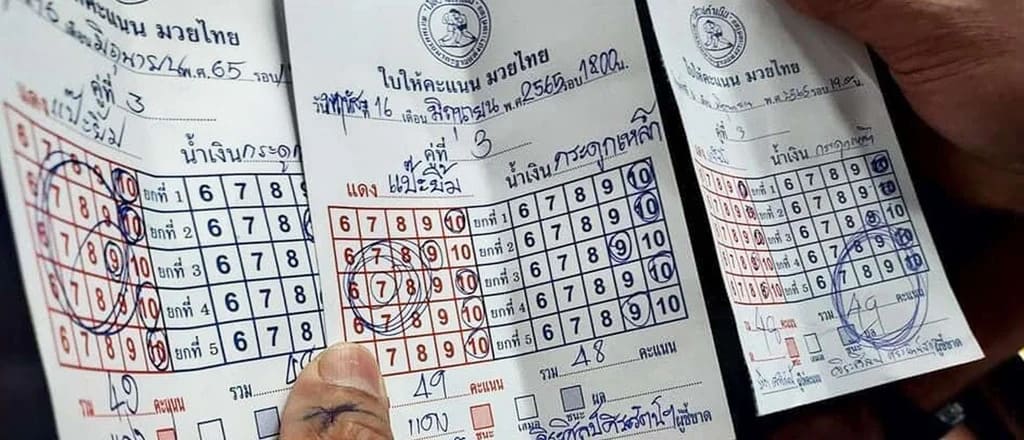
A fighter throws a clean right cross in the second round. It lands flush, the crowd reacts, and on a boxing scorecard that punch would probably tip the round. In a Lumpinee ring, the judge sitting closest to the action barely lifts his pen. Thirty seconds later the same fighter eats a body teep that folds him at the waist for a second, and that’s the moment the scorecard actually moves. Nobody in the cheap seats agrees on why. That gap between what looks decisive and what scores is the whole story of Muay Thai judging, and it’s why so many fans leave a stadium show convinced they just watched a robbery.
Why Muay Thai Scoring Confuses Everyone
If we grew up watching boxing or MMA, we were trained to count. Every landed punch is a tally mark, every combination adds up, and the fighter throwing more volume usually wins the round on our mental scorecard. Muay Thai doesn’t work that way, and nobody warns you before the first bell.
Thai scoring is cumulative and comparative rather than additive. Judges aren’t counting strikes; they’re building an impression of who controlled the round and who absorbed the more meaningful damage. A busy fighter who never threatens can lose a round to someone who landed four significant strikes and looked comfortable doing it. That single idea explains most of the confused reactions you’ll read under any stadium fight clip online.
What Thai Judges Reward
Balance sits at the top of the list, and it’s the hardest concept for outsiders to grasp. A strike that visibly disturbs an opponent’s stance, forces a stumble, or breaks their rhythm counts for more than a strike that lands but changes nothing. This is why a hard low kick to the thigh, thrown with the intent to buckle the leg, often outscores three or four jabs that land clean but leave the recipient standing exactly as he was.
Ring control matters almost as much. A fighter who walks his opponent down, cuts off the ring, and dictates where the fight happens is building a case with the judges even in exchanges where nothing lands. Retreating fighters, even sharp counter-strikers, start every round at a disadvantage in Thailand because retreat reads as concession.
Then there’s the clinch, the part of the sport Western audiences tend to switch off during. Dominant clinch work, off-balancing throws, and knee strikes delivered from a controlling position are scored heavily, sometimes more heavily than the striking exchanges that came before it. A fighter who spends ninety seconds smothering an opponent against the ropes and finishing with two clean knees has, in Thai eyes, done more work than a flurry of arm punches at range.
Effect matters more than contact. A teep to the stomach that visibly winds someone, a question mark kick that snaps the head back, or a low kick that leaves a limp: these register because the judge can see the damage register on the fighter’s body. A grazing jab, however technically clean, often doesn’t.
What Doesn’t Score (and Why)
Western viewers instinctively reward activity. Thai judges don’t, and the gap between those instincts creates most of the disputed decisions online. Strikes that typically go unrewarded include:
- Arm punches thrown at range without weight behind them. They connect, but they don’t move anyone, and a Thai judge reads them as filler.
- Volume for its own sake. Ten touches in a flurry mean less than two strikes that actually shift the opponent’s balance.
- Retreating counters. Landing while backing away can look sharp on camera but reads as defense-first, which Thai scoring treats as a round conceded, not won.
- Early-round output. Rounds one and two are watched for feeling out and positioning far more than for damage. A fighter who burns himself out early without a plan for the middle rounds can work against his own scorecard.
- Aggression without control. Charging forward and swinging wide doesn’t earn credit unless it actually lands with effect or establishes dominant position.
Thailand vs the West: Same Fight, Different Winner
We can watch the exact same three minutes twice and come away with opposite winners depending on which room we’re sitting in.
A Bangkok Panel
In Lumpinee or Rajadamnern, the judges are watching for the story of the round: who imposed himself, who buckled, who controlled the clinch exchanges. A fighter who lands eight strikes but gets thrown twice in the clinch and finishes on the back foot has probably lost that round, regardless of the strike count. The scoring also runs cumulatively across the fight rather than round by round in isolation, so a fighter who dominates rounds three through five can overcome a slow start in a way a Western ten-point system rarely allows.
A Las Vegas Panel
A Western commission judge, trained on boxing’s ten-point-must framework, is counting effective strikes, aggression, and defense in something closer to equal measure, and per round rather than across the whole arc of the fight. That same clinch-heavy round reads differently: fewer visible “strikes,” less obvious activity, and a judge who wasn’t raised on Thai stadium fights may simply not weight clinch dominance the same way. Volume starts to matter more. A busy, forward fighter throwing combinations at range can win rounds in Vegas that he’d lose in Bangkok for the exact same output.
| Scoring factor | Weight in Thailand | Weight in the West |
| Clinch dominance / knees | Very high | Low to moderate |
| Balance disruption | Very high | Rarely scored explicitly |
| Strike volume | Low | High |
| Ring control / cutting off | High | Moderate |
| Damage/effect visible on opponent | High | High |
| Round-by-round independence | Low (cumulative) | High (each round stands alone) |
Neither approach is wrong. They’re measuring different things, and that’s the part most arguments online skip past entirely.
How Rounds Are Weighted
Traditional Thai scoring doesn’t treat each round as its own sealed unit. Rounds one and two are largely a preamble: judges are reading rhythm, gauging power, watching for who’s willing to engage. The real scoring weight sits in rounds three, four, and five, where a fighter who has been patient and conserved energy can take over and effectively erase whatever happened earlier. This is why fighters trained in the Thai system often look passive early and dangerous late, and it’s also why Western fans watching a live stream get restless during round one, assuming nothing is happening when in fact very little is supposed to.
A fight can be close on paper through four rounds and still end as a clear decision because the fifth round carries outsized weight in the judges’ minds. That cumulative logic is baked into the same 10-point must system used at Thai stadiums, which is worth reading on its own if you want the mechanics behind how the numbers actually get assigned round to round.
Scoring in ONE and US Amateur Bouts
ONE Championship uses a version of the 10-point-must system, but its judging criteria have drifted noticeably toward Western instincts over the years. Effective striking and visible damage carry real weight, clinch stalling without output is actively discouraged, and judges are asked to reward output across the whole fight rather than lean almost entirely on the closing rounds. The result is a promotion that markets itself as Muay Thai but often scores closer to how a kickboxing or MMA panel would.
US amateur Muay Thai, run under bodies like IFMA-affiliated commissions, sits somewhere in between. Officials are trained on Thai principles in theory, balance, effect, ring control, but many judges cut their teeth on boxing or kickboxing and default to counting strikes when the fight gets messy. That inconsistency is one reason American amateur cards produce so many split or disputed decisions compared to fights in Thailand, where judges share a single, deeply ingrained frame of reference.
How to Watch a Fight Like a Judge
Stop counting strikes. Start asking who is being pushed backward, who flinches or buckles, and who controls the clinch when things get close. Watch the feet before the hands: a fighter who’s constantly resetting his stance after getting hit is losing the round even if he’s throwing back.
It also helps to know what’s happening ringside. At stadium shows in Thailand, betting among spectators is heavy and constant, and the crowd’s audible reaction, groans, cheers, sudden silence, often tracks the judges’ read of a round more closely than it tracks who “won” the exchange by a Western eye. The room is scoring the fight the traditional way, and the room is usually right about what the judges are about to write down. Controversial decisions do happen, and international audiences amplify them fast whenever a boxing-style tally in their head doesn’t match the cards. Most of the time the real explanation is a scoring philosophy gap, not corruption, even though accusations of fixed cards have trailed the sport for as long as money has changed hands ringside.
FAQ
Why did the fighter who landed more punches lose? Because Thai judges score effect and control, not raw contact. A high volume of light strikes can lose to a handful of strikes that visibly hurt or off-balance the opponent.
Does a knockdown automatically win the round? Not automatically, but it weighs heavily. A knockdown demonstrates the kind of visible effect judges are already looking for, so it usually decides a close round unless the rest of the round clearly favored the other fighter.
Why do fighters look so passive in the first two rounds? Traditional scoring weights the middle and late rounds far more heavily. Fighters conserve energy early because the fight is effectively won or lost from round three onward.
Is Muay Thai judging the same everywhere? No. Stadium fights in Thailand, ONE Championship, and Western amateur or professional commissions all apply different weight to volume, clinch work, and cumulative scoring, even when they claim to use the same 10-point-must system.
Does the gambling at stadium fights actually influence judges? There’s no evidence judges are swayed by ringside betting as a rule, but the culture of heavy wagering does shape how closely the crowd tracks the same criteria the judges use, which is part of why Thai audiences often “call” a decision before it’s announced.

4 Comments